
Summer 2025
Summer 2025
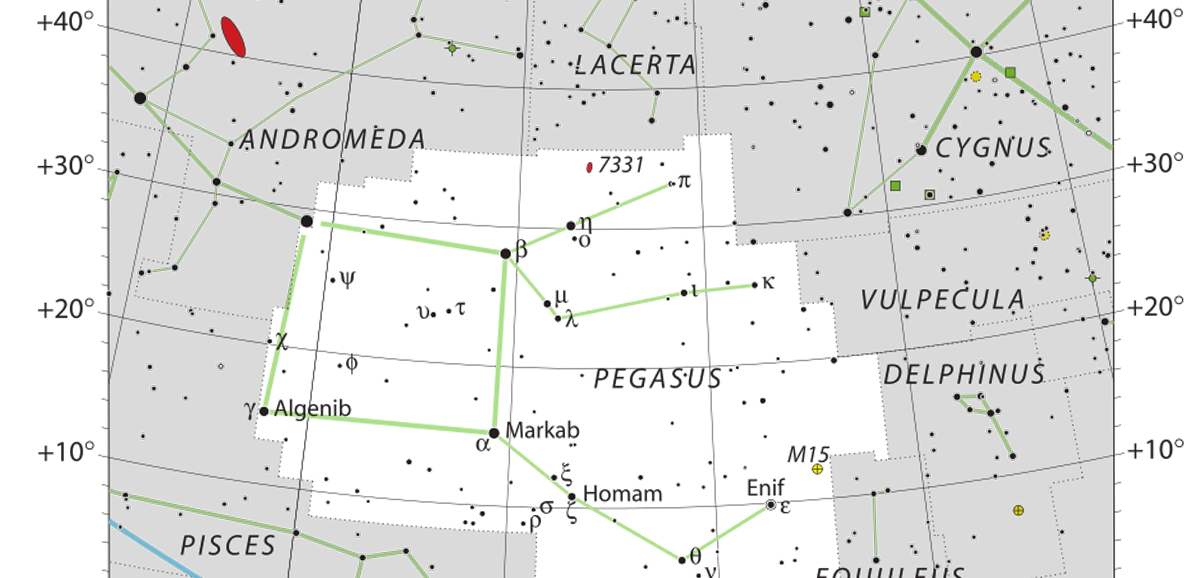
Image: IAU and Sky & Telescope magazine (Roger Sinnott & Rick Fienberg)
By Tom Campbell
Pegasus is one of the most iconic figures in Greek mythology. He sprang from the neck of Medusa when she was slain by Perseus. Born alongside his brother Chrysaor, Pegasus was the offspring of Poseidon, god of the sea. After his birth, Pegasus flew to Mount Helicon, home of the Muses, and created the spring Hippocrene by striking the ground with his hoof - a source of poetic inspiration.
Pegasus later became the steed of Bellerophon, who used him to defeat the fire-breathing Chimera. After many heroic deeds, Bellerophon attempted to ride Pegasus to Mount Olympus, but was thrown off for his hubris. Pegasus, however, reached Olympus and was given the task of carrying Zeus' thunderbolts. As a reward, Zeus placed Pegasus among the stars.
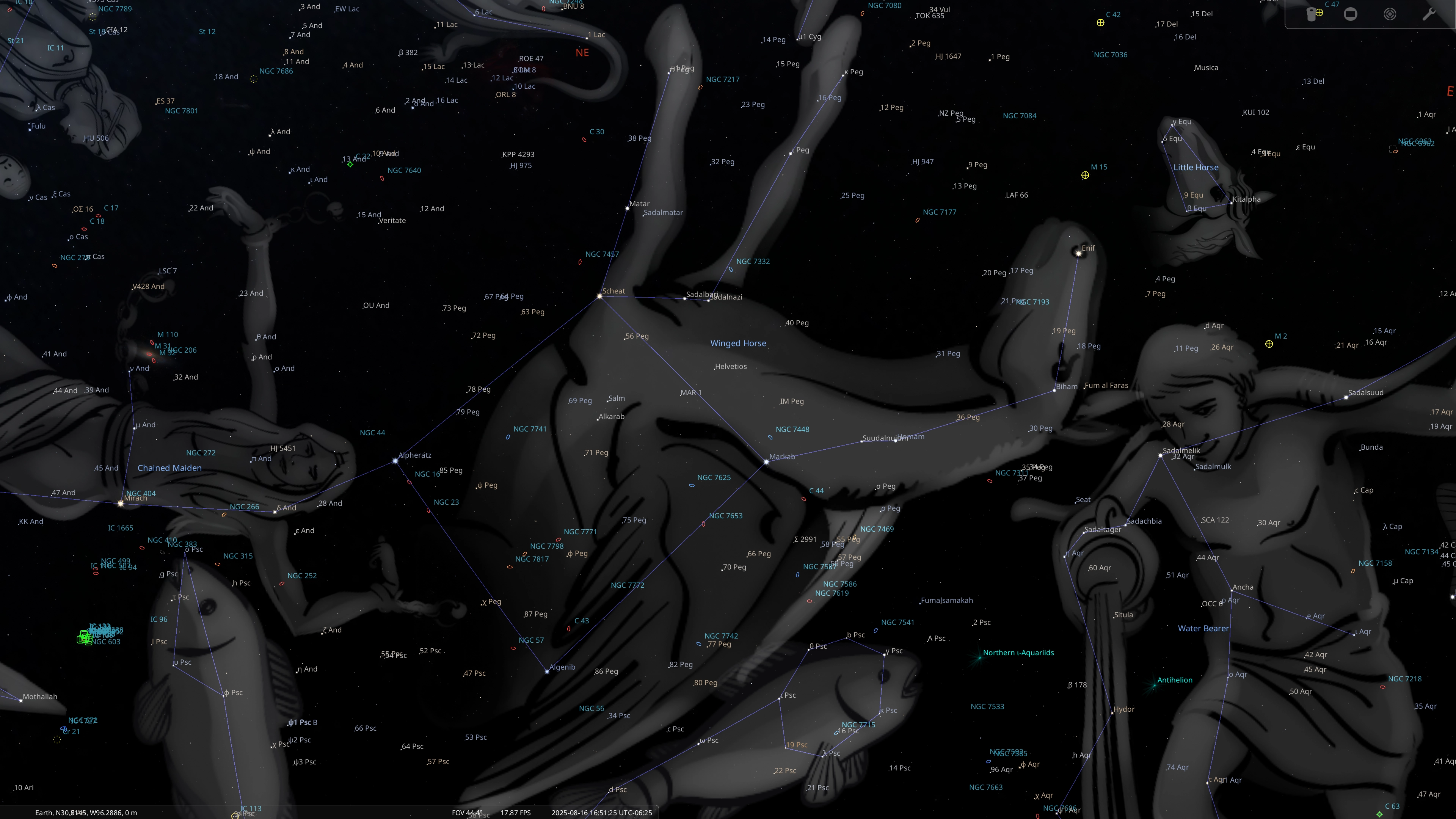
Pegasus - The Winged Horse
Click image to enlarge.
Image generated by Stellarium v25.2
A prominent asterism lies at the border of Pegasus and Andromeda: the Great Square of Pegasus. Formed by the stars Markab (α Peg), Scheat (β Peg), Algenib (γ Peg), and Alpheratz (α And), it was known in Babylonian star lore as IKU, meaning "field." This celestial square likely served as a seasonal marker, signaling the approach of harvest time.
As autumn nights grow longer and cooler, Pegasus rises high in the eastern sky, inviting observers to explore its treasures. Whether you're chasing ancient globular clusters, distant galaxies, or curious double stars, the Winged Horse offers a rich mix of targets for every telescope and skill level.
Messier 15, also catalogued as NGC 7078 and commonly called the Great Pegasus Cluster, is a globular cluster located near the head of Pegasus. I like to call it the Horse Apple due to its location. It's estimated to be 12.5 billion years old, making it one of the oldest known globular clusters.
The cluster is almost 36,000 light years from Earth and 175 light years in diameter. It contains over 100,000 stars and is so tightly packed, it may contain a black hole at its center. My 8-inch Dobsonian was able to resolve several dozen stars about halfway to the center, but a little more aperture will be able to resolve stars all the way in.
Caldwell 30 is a spiral galaxy often called Little Andromeda due to its similar shape and orientation to Messier 31, the Great Andromeda Galaxy. More commonly, it goes by the designation NGC 7331. It was discovered on September 6, 1784 by William Herschel.
One unusual feature of Caldwell 30 is that unlike most galaxies, the central bulge is rotating in the opposite direction of the spiral arms. The core of the galaxy also appears to be slightly off-center.
With an 8-inch Dobsonian in Bortle 5 skies, I logged the following observations for Caldwell 30: Both arms are obvious in this galaxy, along with a small, but not quite stellar core. Compared to the bright core, the arms are rather faint. 81X seemed to be the optimum magnification tonight for viewing the arms of the galaxy, although 122X showed the core a bit better.
Caldwell 43, also known as Little Sombrero due to its resemblance to Messier 104, is an edge-on spiral galaxy. It is also catalogued under the name NGC 7814. William Herschel discovered it on October 8, 1784, describing it as "pretty faint, pretty large, irregularly round, and easily resolvable."
In long exposure images, the starfield surrounding Caldwell 43 is filled with several faint and small background galaxies, reminiscent of the Hubble Deep Field image. The light from these galaxies becomes more red as it passes through the halo of Caldwell 43, providing a means to measure how much dust and gas the halo contains. It is also one of the few bright galaxies that shows some distortion and twisting of the galaxy's plane visually.
Caldwell 44, also known as NGC 7479, is sometimes called the Superman Galaxy or Propeller Galaxy, due to its unusual S-shaped structure. Discovered by William Herschel in 1784, this barred spiral galaxy is notable for its asymmetric arms - likely the result of a past galactic merger.
Visually, the bright core is relatively easy to spot in moderate apertures, but the sweeping arms are much fainter and require dark skies and larger telescopes to detect. Under ideal conditions, observers may glimpse hints of the galaxy’s twisted shape. For astrophotographers, however, Caldwell 44 is a striking and rewarding target, revealing its dynamic structure in long exposures.
Enif (ε Peg) is an orange supergiant star with a radius 183 times that of our own sun. It is an optical double with an 8.7 magnitude star, but they are not part of the same system. It has already exhausted its hydrogen and is now fusing helium in its core. Its mass is near the dividing line between causing a nova or a supernova when it eventually dies.
Having a much dimmer star next to Enif makes it a prime candidate to see the Pulfrich Effect. Center the stars in your telescope at a magnification of about 60-100x. While looking at the pair, tap the side of the eyepiece to make the view jiggle perpendicular to both stars. Enif will appear to move normally back and forth, but the fainter star will appear to swing like the pendulum of a clock, but out of sync. Scientists believe this is caused by the fact that it takes our eyes a fraction of a second longer to register the fainter star's light on our retinas. For this reason, Enif and its unrelated companion are sometimes called the Pendulum Star.
These were my notes with an 8-inch Dobsonian: This is a wide optical double, even at 49X. The main component is an extremely bright yellow star. The bluish companion is quite a distance away and is several magnitudes fainter. The separation is so wide and the magnitudes are so far apart that they don't really even look like a binary system. However, the color contrast is nice.
85 Peg is a binary system consisting of a yellow dwarf primary and an orange dwarf companion. The pair orbits each other with a period of about 26 years, and while they are visually separable in amateur telescopes under good conditions, the separation is modest and may require higher magnification. Interestingly, 85 Peg B is suspected to have a red dwarf companion of its own, but this third star is too close to be resolved visually.
Matar (η Peg) is a binary star system whose name means "lucky star of rain" in Arabic. The primary is a pale yellow giant, while its companion is a white main-sequence star. Two other nearby stars may or may not be gravitationally bound to the system, making Matar a possible quadruple system.
Though not especially prominent in small telescopes, Matar is a good target for double star enthusiasts interested in subtle color contrasts and complex stellar relationships. Its brightness and location near the Great Square also make it a useful reference point when starhopping through Pegasus.
π Peg is an optical double star, meaning its two components appear close together from our vantage point on Earth but are not physically related. In reality, the stars are separated by over 50 light-years. The pair consists of π1 Peg and π2 Peg, which lie about 10 arcminutes apart on the sky—wide enough to be easily split in binoculars or a small telescope.
Though not especially colorful or gravitationally bound, π Pegasi makes for a pleasant visual pairing and a useful reference point when navigating the northern reaches of Pegasus.
Pegasus may have soared from myth into the stars, but its celestial form continues to inspire. From the tightly packed stars of Messier 15 to the distant spirals of Caldwell 30 and 44, the Winged Horse carries a sky full of stories. So next time you set up your scope, take a moment to ride alongside Pegasus - and see what wonders await.
| Object | Type | Mag(s) | Distance (ly) | R. A. | Dec. |
|---|---|---|---|---|---|
| Messier 15 | Globular Cluster | 6.2 | 33,600 | 21h 30m | +12° 10' |
| Caldwell 30 | Spiral Galaxy | 10.4 | 43,800,000 | 22h 37m | +34° 25' |
| Caldwell 43 | Spiral Galaxy | 11.6 | 40,000,000 | 00h 03m | +16° 09' |
| Caldwell 44 | Spiral Galaxy | 11.6 | 105,000,000 | 23h 05m | +12° 19' |
| ε Peg | Orange Supergiant | 2.4 | 690 | 21h 44m | +09° 52' |
| 85 Peg | Double Star | 5.8, 8.9 | 39.5 | 00h 02m | +27° 05' |
| η Peg | Double Star | 2.9, 6.5 | 196 | 22h 43m | +30° 13' |
| π Peg | Optical Double Star | 4.3, 5.6 | 263 | 22h 09m | +33° 10' |
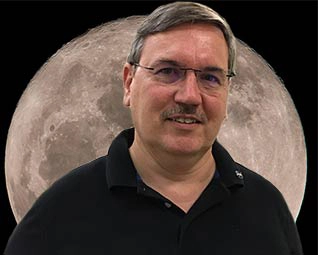
About the Author:
Once upon a time, a wide-eyed toddler watched the Moon landings on a flickering black-and-white TV and decided that space was way cooler than cartoons. That toddler was Tom Campbell, who grew up to be a software developer, NASA Solar System Ambassador, and seasoned astronomy educator.
For years, Tom and his trusty Dobsonian telescope have traveled across Texas, leading hundreds of outreach events and helping thousands of people peer into the cosmos. He served as the Outreach Coordinator for the Brazos Valley Astronomy Club for eight years, growing its public outreach and inspiring countless stargazers.
But beware! The wicked Witch-Head Nebula once cursed him with eternal cloud cover. Ever since, Tom has battled the skies with weather apps, backup solar system models, and an unshakable optimism that even the gloomiest forecast can't dampen.
When he's not dodging clouds, Tom writes stories, such as the Stargazer Sue children's books, which inspire young explorers to look up and wonder. These days, he continues to share the night sky with the community - living happily ever after in College Station with his wife and an ever-growing family of telescopes - whenever the skies allow.
Website: http://astro.tomandjul.com/
Contact: avid.astronomer@outlook.com

FIND US ON THE WEB:
www.brazosvalleyastronomyclub.org
© Brazos Valley Astronomy Club
Newsletter Editor: Ginger Wentrcek
MEMBERSHIP QUESTIONS:
brazosvalleyac@gmail.com
Treasurer - Lee Smith