
Summer 2025
Summer 2025
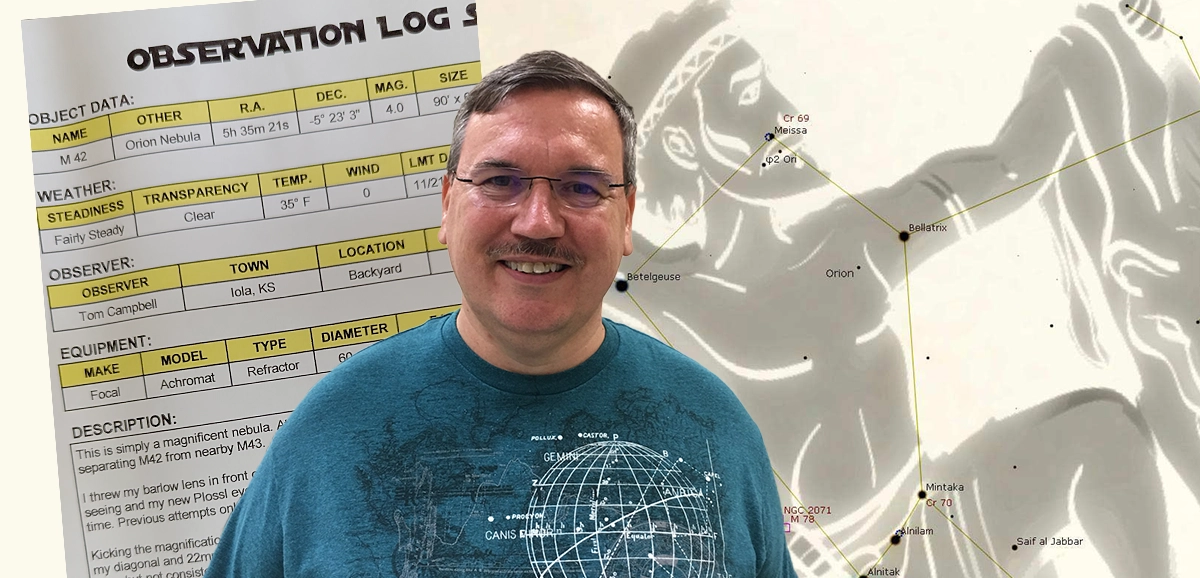
By Tom Campbell
There's something quietly profound about sitting alone under the stars while the rest of the world (or about half of it, anyway) sleeps. The telescope hums softly as it speeds towards your latest quarry, an owl wonders "who? who?" is disturbing the stillness, and the sky offers up its secrets one object at a time. But as vivid as those moments feel, they fade - sometimes faster than we'd like. That's where the observing log comes in.
Logging your observations isn't just a way to keep records. It's a way to learn, to grow, and to remember. Whether you're a seasoned observer or just starting out, keeping a log can transform your stargazing from a series of disconnected nights into a coherent journey through the cosmos.
There are plenty of good reasons to keep an observing log, and you may have your own list, but here are a few that stand out for me:
Some observers use structured templates; others prefer freeform journaling. The best format is the one you'll actually use. The information I track in my logs has changed greatly over time as I've grown as an observer, and that's part of the story, too.
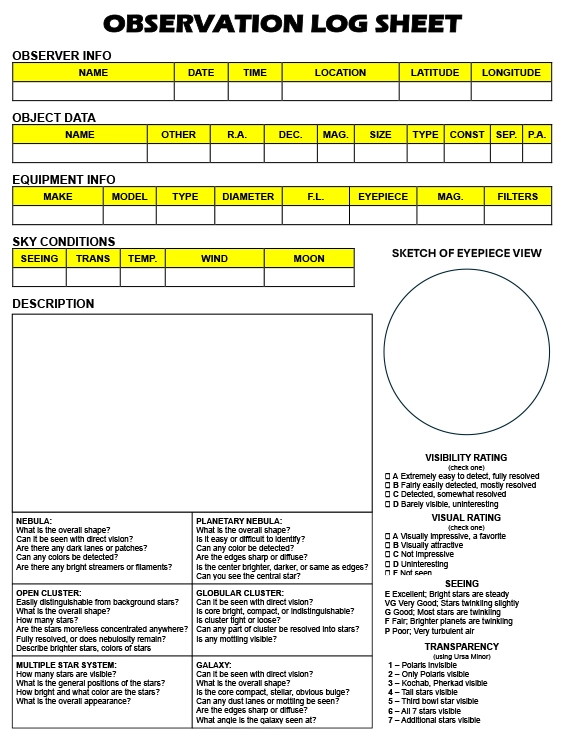
Click the sample above for a full size pdf of the Observation Log Sheet. You may download the pdf.
There's no single right way to keep an observing log, but most entries should include at least a date and an object description. Other than that, it's entirely up to you and what you deem to be important. Here is some information to consider logging:
Some observers use structured templates; others prefer freeform journaling. The best format is the one you'll actually use. The information I track in my logs has changed greatly over time as I've grown as an observer, and that's part of the story, too.
If you've never logged before, don't worry about doing it "right." Just start. A small notebook, a voice recorder, or a notes app on your phone can all work. Keep it simple at first - maybe just jot down the date, object, and a few thoughts. You can always expand later.
During observing, keep your log accessible. A clipboard with a red flashlight works well. If you're using a phone or tablet, consider a red screen filter to preserve night vision. And if you're too cold or tired to write in the moment, make a few quick notes and flesh them out the next day.
Some observers prefer to log after the session, when they're warm and rested. Others jot notes in real time. Try both and see what fits your style.
So what works for me? I found that using a voice recorder app on my phone to record my notes at the eyepiece works well, and I don't have to fiddle with notebooks or pencils in the dark. This method doesn't work well in a noisy environment because the phone will pick up a lot of extra noises. In my driveway, however, it works great, as long as a jogger isn't going past and thinks I'm talking to myself. The next morning, or whenever I get the time, I use a PC app to transcribe these voice files to text and add them to my online database of entries. I call them StarLogs.
If you're not sure where to start, I've included a downloadable observing log sheet I developed years ago. It's designed to prompt useful observations for a variety of object types - galaxies, clusters, nebulae, and more - and includes fields for equipment, sky conditions, and visibility ratings. I like it because it reminds me what to look for with each object type, especially on nights when I'm tired or distracted. You can download the log sheet here and adapt it to your own observing style.
I've found that logging my observations has changed the way I observe. It's no longer just about checking objects off a list - it's about noticing, remembering, and reflecting. Some of my favorite entries aren't about rare or difficult targets; they're about quiet moments when everything just worked. The sky was clear, the scope was aligned, and the object in the eyepiece looked almost exactly like the picture on the Internet - only better, because I was seeing it for myself.
I've also had nights where nothing went right. The dew was relentless, the GoTo refused to cooperate, and the clouds rolled in just as I found my first target. But even those nights have a place in the log. They're part of the story.
You don't need fancy gear or perfect skies to keep an observing log. All you need is a desire to remember what you saw when you weren't sleeping. Over time, your log will become more than a record - it'll be a companion. A quiet witness to your nights under the stars.
So grab a pencil, open a file, or start a sketchbook. The sky is waiting - and it has stories to tell.
About the Author:
Once upon a time, a wide-eyed toddler watched the Moon landings on a flickering black-and-white TV and decided that space was way cooler than cartoons. That toddler was Tom Campbell, who grew up to be a software developer, NASA Solar System Ambassador, and seasoned astronomy educator.
For years, Tom and his trusty Dobsonian telescope have traveled across Texas, leading hundreds of outreach events and helping thousands of people peer into the cosmos. He served as the outreach coordinator for the Brazos Valley Astronomy Club for eight years, growing its public outreach and inspiring countless stargazers.
But beware! The wicked Witch-Head Nebula once cursed him with eternal cloud cover. Ever since, Tom has battled the skies with weather apps, backup solar system models, and an unshakable optimism that even the gloomiest forecast can't dampen.
When he's not dodging clouds or transcribing StarLogs, Tom writes stories, such as the Stargazer Sue children's books, which inspire young explorers to look up and wonder. These days, he continues to share the night sky with the community - living happily ever after in College Station with his wife and an ever-growing family of telescopes - whenever the skies allow.
Website: http://astro.tomandjul.com/
Contact: avid.astronomer@outlook.com

FIND US ON THE WEB:
www.brazosvalleyastronomyclub.org
© Brazos Valley Astronomy Club
Newsletter Editor: Ginger Wentrcek
MEMBERSHIP QUESTIONS:
brazosvalleyac@gmail.com
Treasurer - Lee Smith