
By Tom Campbell
The constellation of Taurus represents a bull. The head, shoulders and forelegs are represented in the sky. According to Greek mythology, Zeus, the king of the gods, once fell in love with Europa,the daughter of the king of Sidon. He came to Earth disguised as a white bull, to watch her.
Europa was playing on the beach one day with her friends near her father's herd of cattle. She looked up and noticed a beautiful white bull in the herd. Intrigued by its beauty, she went up to him, stroked him, and adorned him with flowers she picked in the meadow.
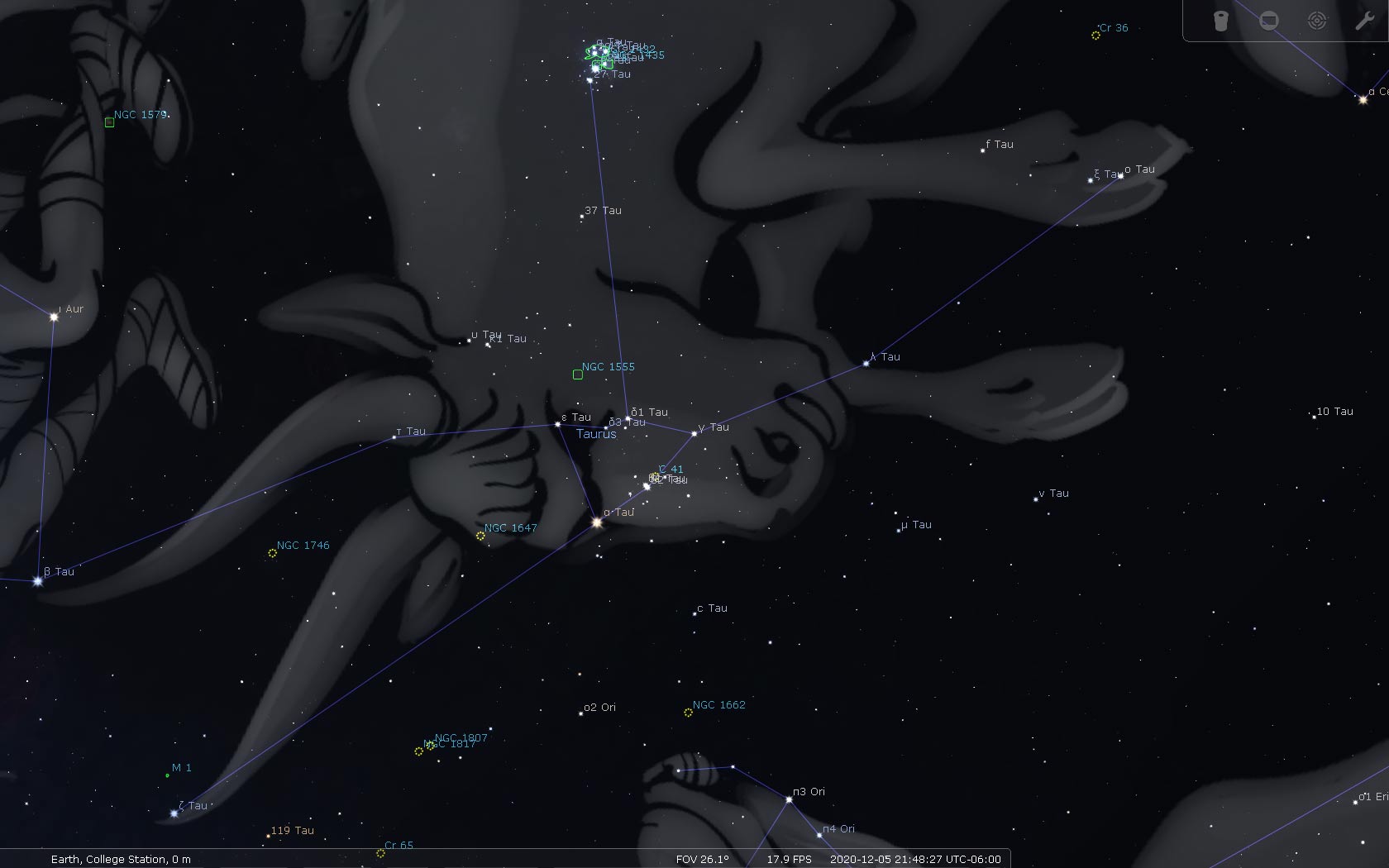
Taurus - The Bull
Click to enlarge.
Image generated by Stellarium v23.2
Because the bull was so friendly, she decided to climb on his back and ride him. As soon as she sat down, Jupiter ran off with her into the sea and swam all the way to Crete. Europa ended up having three children with Zeus, one of whom would grow up to become King Minos. Zeus was so pleased with Europa that he decided to place a bull in the sky to commemorate the event.
The constellation of Taurus is home to two of the closest open clusters to Earth, the Pleiades and the Hyades. Both clusters can be seen with the naked eye from even moderately light-polluted skies.
χ (Chi) Tauri is a colorful double star system. The main star has a magnitude of 5.4, making it visible with the naked eye from a dark sky. It is a blue-white main sequence star about 2.6 times more massive than our own Sun. The companion is actually itself a spectroscopic binary, of types F and G.
Here were my notes through an 8-inch reflector, "This double is wide, easily split at 49x. The best view is at 81x, however. The primary is bright white, with a tinge of blue, and the companion is a few magnitudes fainter, appearing a dull yellow, almost brown. That's an unusual star color, and it might be due to either atmospheric effects or the relative faintness of the secondary."
118 Tauri was first noted by William Herschel on December 7, 1782 (he catalogued it as "H II 75"). The pair appear as white and blue-white and are easily split in small telescopes.
My notes through an 8-inch reflector: "This double is easy to spot, halfway between the two horntips of Taurus. The pair is much brighter than any other field star, making them stand out. 125x offers the best view. The brighter star is milky white and the slightly fainter companion is pale blue. This is a decent-looking pair, and are cleanly split."
Messier 1 is also known as the Crab Nebula. Although it was first observed in 1731 by the English astronomer John Bevis, it wasn't until the early 20th century that it became apparent that the nebula was slowly expanding. Using its calculated expansion rate, scientists backtracked the date of its formation to the mid-11th century. Looking through ancient records, they discovered Chinese astronomers mentioned a "guest star" which appeared in 1054 AD and was bright enough to be seen during the daytime for a short period of time. A star that bright which was only visible for a short time could only be a supernova, and thus the Crab Nebula was the first discovered supernova remnant.
With an 8-inch reflector, I noted: "At 49x, it's fairly faint, but definitely visible as a dim, blurry smudge of irregular shape. 122x makes it appear larger and noticeably oblong. Next to it lies the mag. 6.9 star TYC 1310-1195-1, which makes the job of focusing much easier. The nebulosity was fairly uniform, except for fading out a bit near the edges. At times, I thought I could start to make out tendrils near the edge of the nebula."
Messier 45 is also known as the Pleiades, or Seven Sisters. At a distance of 444 light years, it is the nearest Messier object to Earth. The star cluster is dominated by hot blue luminous stars that have formed within the last 100 million years. The reflection nebulae associated with the cluster is now believed to merely be a dust cloud through which the cluster is currently passing.
In my binoculars, dozens of stars are visible. The seven brightest ones stand out prominently, with a multitude of fainter ones interspersed throughout the cluster. The entire cluster easily fits within the field of view. One of the stars, Alcyone, particularly caught my attention because of a fainter star right next to it that made for a nice visual binary.
This cluster is absolutely gorgeous, with several small chains and patterns of stars. I never get tired of looking at it. The overall shape of the cluster reminds me of an outline of the Apollo lunar lander. With the naked eye (well, almost naked, since I do wear glasses), I could pick out six of the brightest stars (all but Pleione), so the seeing must've been fairly decent.
Caldwell 41, more commonly called The Hyades, is the nearest open star cluster to Earth and one of the best-studied ones. The five brightest members have consumed the hydrogen fuel at their cores and are now in the process of becoming giant stars. Four of these mark an asterism known as the head of the bull, and the fifth is the bull's eye.
This large open cluster is almost too close to appreciate. Through a telescope, only small sections of the cluster can be seen at a time. Even in binoculars, the entire cluster won't fit into the field of view. Besides the familiar V shape that makes up the head of Taurus, there are a few other interesting patterns of stars within the Hyades. My favorite is a little asterism near Aldebaran which consists of three double stars in a circle, forming a sort of triangle with the ends chopped off, similar to the triangular caution sign that you see on the back of farm equipment travelling down the road.
British astronomer John Russell Hind discovered the emission nebula NGC 1555 in 1852. It remained visible for a few years, but then faded from view. Russian astronomer Otto Wilhelm von Struve later observed the nebula, but it had disappeared again by 1868. In 1890, American astronomer Edward Emerson Barnard found a position error for the star T Tauri and suggested that other astronomers had been looking in the wrong place for NGC 1554. Using a 36-inch refractor at Lick Observatory, he glimpsed a faint nebula at the position he had calculated, along with NGC 1555. No observer has seen NGC 1554 since. NGC 1554 has become known as Struve's Lost Nebula and NGC 1555 has earned the moniker Hind's Variable Nebula.
NGC 1555 is a difficult object to observe visually, due to its proximity to nearby T Tauri. Also, the variability of T Tauri will have an effect on how bright the nebulosity appears. However, in recent years, the nebula has been around magnitude 9, which is definitely within reach of a decent telescope in a dark sky.
NGC 1647 is an open cluster containing about 90 stars. It was discovered by William Herschel in 1784, and is about 1,800 light years away.
This is a large open cluster. Stars are fairly faint, but it is somewhat rich, with perhaps 20-30 members spread out across the entire field of view in my 18mm (84x) eyepiece. It is generally round in shape, with a lot of pairs of stars.
NGC 1817 is an open cluster first discovered by William Herschel in 1784. NGC 1807 is very nearby and may in fact be part of the same extended cluster.
Through an 8-inch reflector telescope, it appears as a fairly large open cluster. The best view is at 81x, where it fills up most of the field of view. About a dozen bright stars can be seen, forming a sort of kite shape. Several fainter stars are interspersed within, showing up best with averted vision.
| Object | Type | Mag(s) | Dist. (ly) | R. A. | Dec. |
|---|---|---|---|---|---|
| χ (Chi) Tauri | Double Star | 5.4, 8.4 | 291 | 04h 22.6m | +25° 38' |
| 118 Tauri | Double Star | 5.8, 6.6 | 434 | 05h 29.3m | +25° 09' |
| Messier 1 | Supernova Remnant | 8.4 | 6,500 | 05h 34.5m | +22° 01' |
| Messier 45 | Open Cluster | 1.6 | 444 | 03h 47.4m | +24° 07' |
| Caldwell 41 | Open Cluster | 0.5 | 153 | 04h 27.0m | +15° 52' |
| NGC 1555 | Emission Nebula | 10.0 | 400 | 04h 22.9m | +19° 32' |
| NGC 1647 | Open Cluster | 6.4 | 1,800 | 04h 45.9m | +19° 08' |
| NGC 1817 | Open Cluster | 7.7 | 6,430 | 05h 12.4m | +16° 41' |
About the Author:
Tom Campbell is a software developer, children's book author, and NASA/JPL Solar System Ambassador who is frequently seen sharing his love of the universe with others.
Website: http://astro.tomandjul.com/
Contact: contact@brazosvalleyastronomyclub.org

Winter 2024 Newsletter

CONTACT EMAIL:
contact@brazosvalleyastronomyclub.org
Coordinator - Randy Light, M.D.
PROGRAM REQUEST EMAIL:
outreach@brazosvalleyastronomyclub.org
Coordinator - Tom Campbell
GOOGLE DISCUSSION GROUP:
https://groups.google.com
Coordinator - Randy Light, M.D.
WEBSITE AND NEWSLETTER EMAIL:
webmaster@brazosvalleyastronomyclub.org
Coordinator - Ginger Wentrcek

Follow Us on Facebook
Member: Astronomical League

Member: Night Sky Network
BVAC Website:
https://brazosvalleyastronomyclub.org
© Brazos Valley Astronomy Club
The Brazos Valley Astronomy Club is a non-profit group
located in Bryan-College Station, Texas.
Our goal is to promote astronomy and related science
as a hobby for people of all ages.