
By Tom Campbell
Many of us remember back in 1994 when the comet P/Shoemaker-Levy 9 passed near Jupiter, broke apart, and made impact "scars" in the upper clouds that were visible for several days. Scientists estimated that such an impact might occur once every 100 years, but that was just a guess based on observers getting lucky and seeing an impact (or the temporary scar of an impact). How can we know for sure?
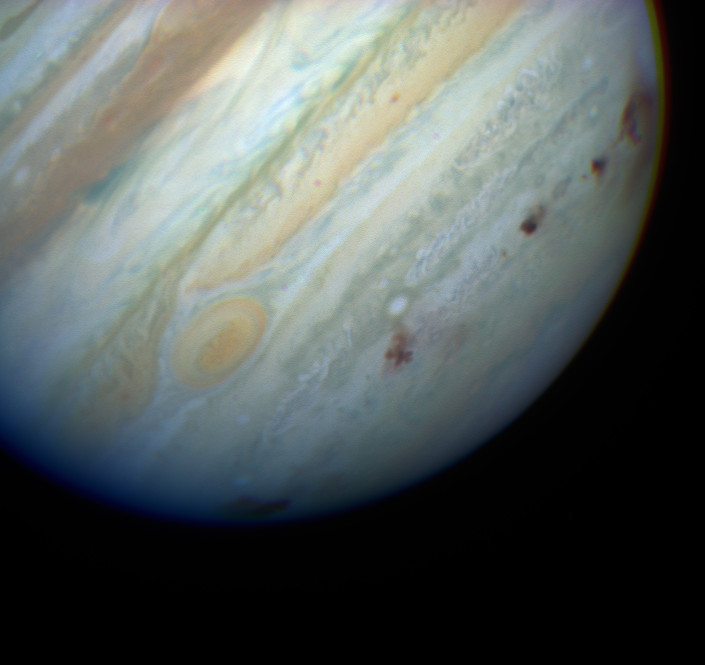
Comet P/Shoemaker-Levy 9 makes several impact marks on Jupiter as fragments crash through its outer atmosphere.
Image courtesy of Hubble Space Telescope Comet Team and NASA.
Most might think that professional astronomers have an eye on our solar system continuously. However, there are only about 10,000 professional astronomers in the world. Most of these are focusing all of their telescope time looking at distant galaxies or certain types of stars. The world's largest and best telescopes are rarely, if ever, looking at Jupiter or Saturn.
That leaves it up to us amateurs. By ourselves, we can't do much. We have to contend with light pollution, cloudy skies, wind, work, shopping, and a host of other conditions that limit our time at the telescope. If we're lucky, we can image the planets a few times per month. The chances of seeing an impact during those few precious minutes at the eyepiece are very slim.
However, we are not alone. There are thousands of amateur astronomers in hundreds of countries, and at any given time of day, someone, somewhere is probably looking at Jupiter or Saturn. On the rare occasion when an impact does happen, chances are good that someone may have captured it.
In fact, if you have ever imaged Jupiter or Saturn, you may have an impact event captured in your data and don't even realize it. Impact flashes typically last about two seconds. If you're stacking even a short video, these few frames will probably either get averaged or thrown out altogether from the final image as random noise.
In 2013, amateur astronomer Luis Calderon developed a software package called DeTeCt, to automatically parse images for the telltale signs of an impact on Jupiter. Marc Delcroix made some improvements to the algorithm and later collaborated with Ricardo Hueso to create an online repository where astronomers could run the software on their own datasets and upload the logged findings to an international database.
In the years since, improvements have been made to the code to help distinguish between impacts and other surface irregularities, such as camera noise, satellite or moon transits, dust on the lens, etc. The online database has also been expanded to include impact data for Saturn.
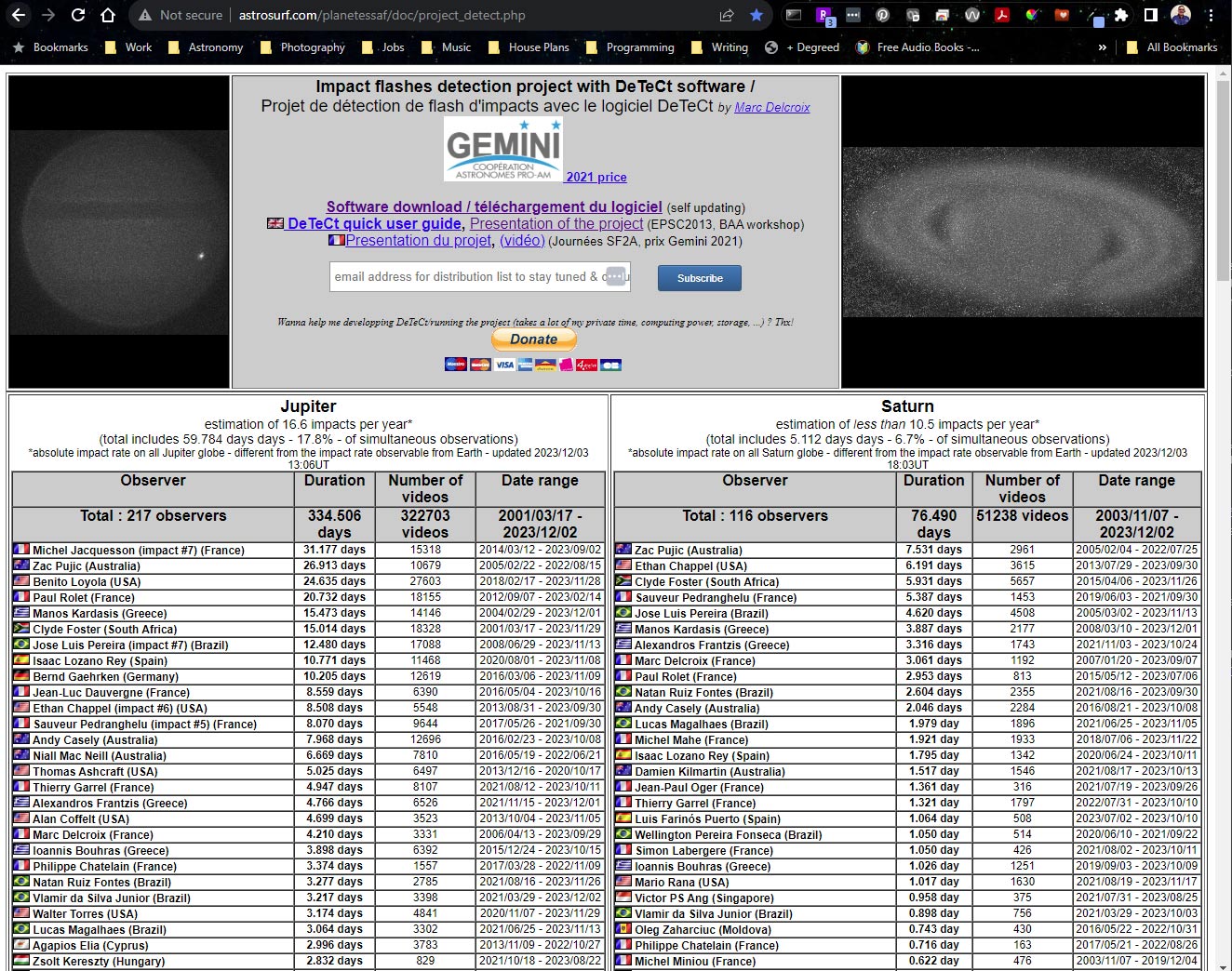
DeTeCt's worldwide current results page.
Download DeTeCt software here.
To join the list of collaborators on this project, you only need a copy of the DeTeCt software, a camera, and a telescope (or telephoto lens) capable of capturing video images of Jupiter and/or Saturn. The software does require a minimum size for the planet image of at least 58x58 pixels.
The latest version of the software can be found at the "Software download" link on the above-referenced page. Once there, click on the DeTeCt vX.Y.Z.zip link near the bottom of the page and then unzip the software to the desired location. I recommend C:\DeTeCt, but anywhere is fine.
The program is self-contained, meaning you don't have to run any installation software to set up additional files and variables. Once it is installed, go into that folder and double-click on DeTeCt.EXE to run the software.
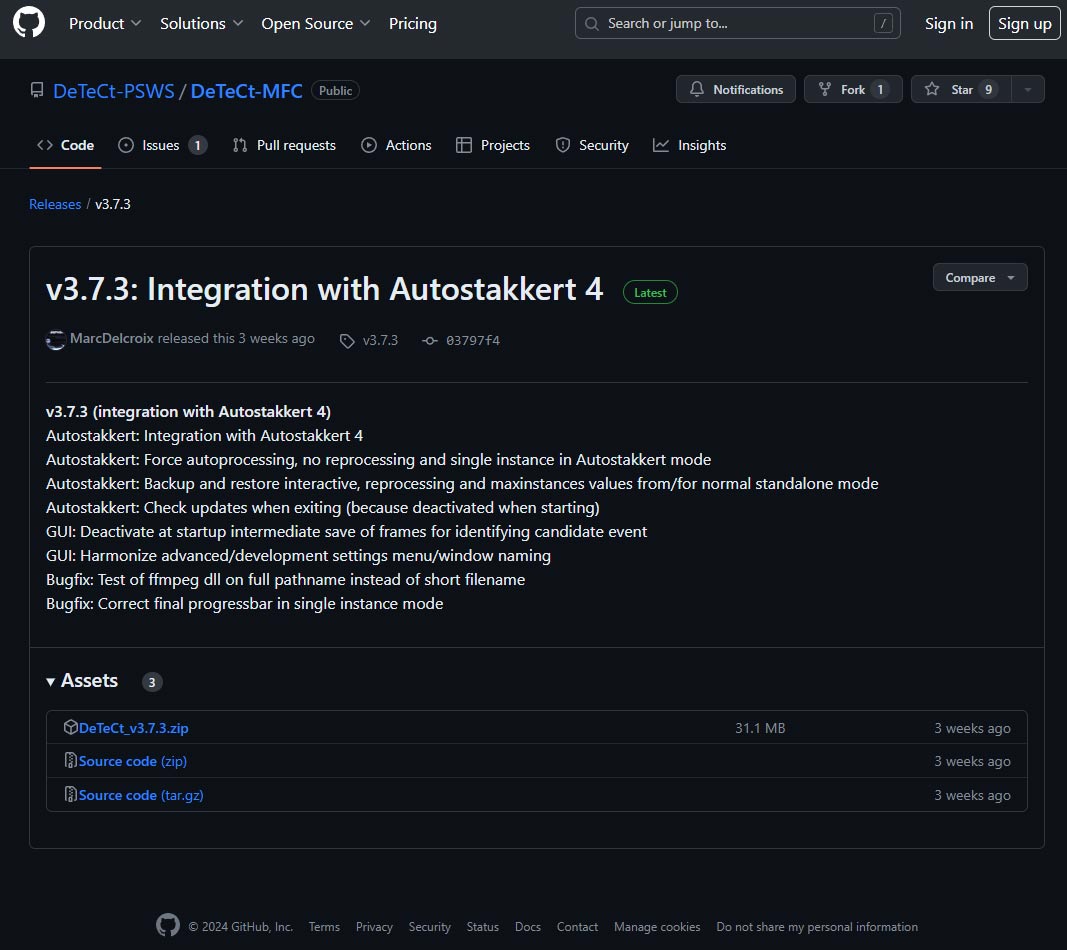
DeTeCt download page.
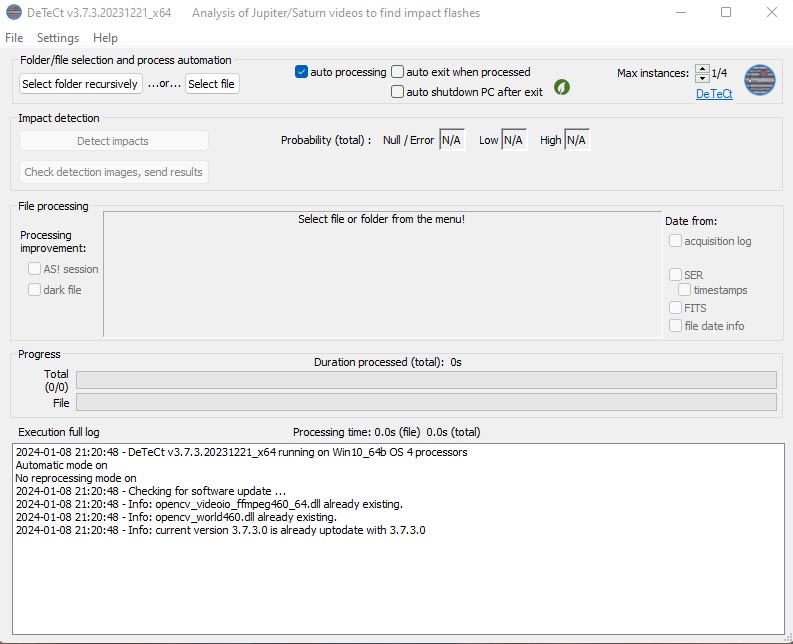
DeTeCt main screen
You should be able to use the program with the default values. Click the "Select file" button if you want to process a single planetary video file, or click "Select folder recursively" to process all planetary image files within a folder and its subfolders. Once a file or folder has been selected, the software will automatically begin processing and will display log messages at the bottom of the screen and show a progress bar right above the log. Depending on the size of the files and the speed of your computer, this could take a long time to complete.
When finished, the software will have produced a single image file of either Jupiter or Saturn (depending on what was in the original file). This image will not be pretty, but is designed to make it easier for the detection algorithms to find evidence of impacts. Your results will be shown near the top of the screen. The image(s) will be flagged as: Null/Error, Low, or High.
In either case, check the original video file closely. The log file will give you frame numbers to check, so you know about where in the video file to look. False positives can be given for a variety of reasons, such as the presence of a transiting Moon, a jet passing through the frame, a passing cloud, random read noise, etc. A true impact event will make a bright flash for two or three seconds before fading out again.
Regardless of the results, when the process has finished, click on the "Check detection images, send results" button in the Impact Detection section of the screen. This will automatically pull up the generated impact image (with suspected impact point highlighted) and will open an email to the author for you to include the DeTeCt-generated data file and submission information. Don't forget to include your name and email address on the email for proper credit. Even if the results are negative, it is important to send this information, as the author's intent is to get as complete of a record as possible for both Jupiter and Saturn, and to determine a good average for how many actual impacts occur per year.
By listing your name and other pertinent details, you will get your name added to the website shown near the top of this article along with how many total "days" worth of data you have processed.
About the Author:
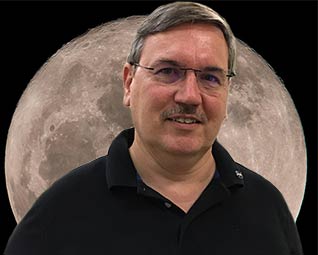
Tom Campbell is a software developer, children's book author, and NASA/JPL Solar System Ambassador who is frequently seen sharing his love of the universe with others.
Website: http://astro.tomandjul.com/
Contact: contact@brazosvalleyastronomyclub.org

Winter 2024 Newsletter

CONTACT EMAIL:
contact@brazosvalleyastronomyclub.org
Coordinator - Randy Light, M.D.
PROGRAM REQUEST EMAIL:
outreach@brazosvalleyastronomyclub.org
Coordinator - Tom Campbell
GOOGLE DISCUSSION GROUP:
https://groups.google.com
Coordinator - Randy Light, M.D.
WEBSITE AND NEWSLETTER EMAIL:
webmaster@brazosvalleyastronomyclub.org
Coordinator - Ginger Wentrcek

Follow Us on Facebook
Member: Astronomical League
Member: Night Sky Network
BVAC Website:
https://brazosvalleyastronomyclub.org
© Brazos Valley Astronomy Club
The Brazos Valley Astronomy Club is a non-profit group
located in Bryan-College Station, Texas.
Our goal is to promote astronomy and related science
as a hobby for people of all ages.