
Spring 2024
Spring 2024
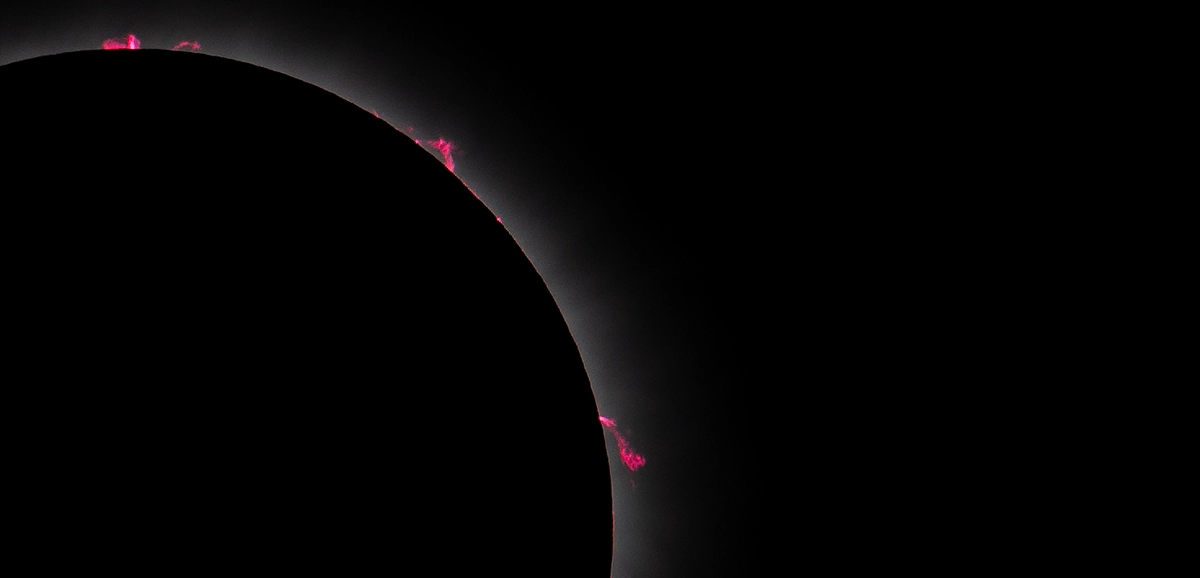
By Ginger Wentrcek
The long-awaited 2024 solar eclipse was fast approaching, and the to-do list seemed to grow longer as the April 8 date approached. One of the critical decisions to be made was, as the saying goes, 'location, location, location,' and I was grateful to be able to stay with my sister and brother-in-law in Gustine, Texas, where totality would last 2 minutes and 35 seconds. I ordered extra memory cards and a right-angle finder and was fortunate to get a solar photography lesson from Dr. Randy Light before the event, which proved to be invaluable.
The equipment used to photograph the eclipse was a Nikon D810 camera, an MC-36A Multi-Function Remote Cord, and an AF-S NIKKOR 600mm f/4E FL ED VR lens, attached to a Wimberley WH-200 Gimbal Tripod Head II and mounted on a Really Right Stuff tripod. A Meade glass white-light solar filter protected the lens.
In the days leading up to the eclipse, test shots of the sun with all camera setting combinations of ISO 200 and 400 with apertures of f/8 and f/11 and shutter speeds between 1/4 and 1/2000 were taken and compared to determine which combination produced the sharpest, clearest photos. Looking back over my notes, I scribbled something on a piece of paper that indicated f/8, ISO 200, 1/500 sec was "best on Sunday with no clipping." (Does that mean that the combination would still hold true for other days of the week?)
It was important to get a feel for adjusting camera settings during fast-changing eclipse phases and not wait until the big event to experiment. To get a feel for taking images leading up to and during totality, when the landscape was supposed to turn to darkness, I set up the camera equipment early on several mornings and waited for first light when conditions were similar to what I expected before and during totality. Photos were taken in low light when the sun was still below the horizon, and, again, just as it was barely peeking over the horizon, to evaluate camera settings that produced the sharpest images in low light. (Side note - it was much darker during totality than I imagined.)
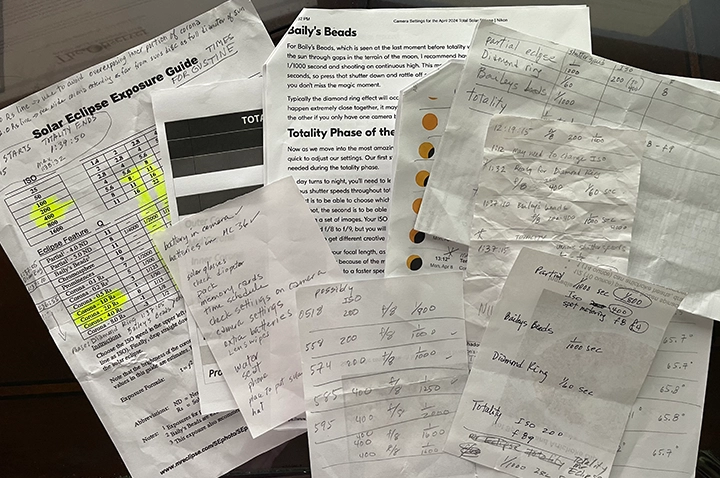
A few preparation notes
My sister, Shirley, did not initially plan to photograph the eclipse - she was going to observe and enjoy the event. However, after we discussed her options, she decided, at the last moment, to use her Nikon Coolpix P1000 point-and-shoot camera, which she typically uses for her birding trips, and let the camera handle the settings for the various phases of the eclipse. She ordered a solar filter two days before we left for Gustine, had it delivered overnight, and I loaned her a tripod and a Wimberley Gimbal Head attachment. As soon as her solar filter arrived in the mail, we left for Gustine. Her total eclipse and Diamond Ring photos are posted below.
Like everyone who was hoping to see the rare eclipse, we watched the weather reports for weeks in hopes there would be a hint that April 8 would be a sunny, cloudless day. Weather records indicated that, historically, on April 8, Gustine had clear skies 54.4% of the time. We had already decided that no matter what weather conditions we experienced on the day of the eclipse, we would be happy and thankful for the day. If the clouds covered the sky, we would still have the opportunity to witness some of the interesting ground-level phenomena associated with the eclipse. We could still witness a change in light levels, experience a drop in temperature, feel wind changes, and listen to and observe birds and animals (the neighbor's chickens).
We chose to set up in a back pasture that offered an unobstructed view of the sky from 60 degrees to 58.8 degrees. This viewing area was essential for observing the entire eclipse from start to finish without any trees blocking our line of sight. It was a stunning location, situated right in the midst of blooming Texas bluebonnets.
Monday, April 8, the day of the eclipse, THE BIG DAY of 2024, arrived, and skies were clear in the early morning hours. I went outside and took a few more practice photos when the sun was still below the horizon and again as it started to rise above the horizon. But, in the distance, a large bank of clouds looked like it was heading our way. Within a couple of hours, the sky was covered in thick clouds. But that was okay; we would go to Plan B and enjoy our day together, observing the ground-level changes we could see below the cloud cover.
Under a total cloud-covered sky, we set up our equipment in the back pasture. I did a dry run of photographing the eclipse, a pantomime so to speak - pretend to check camera settings, pretend to check to see that memory cards were in the camera, pretend to snap photos of first contact, pretend to check timer on iPhone signaling time to change camera settings for different phases, pretend to remove filter, pretend to lay filter - somewhere.
That little exercise proved to be valuable because I did not have a place on which to safely lay the filter when it was time to remove it. I went through all of the steps and felt that we were ready, in case we could see some of the eclipse through the clouds.
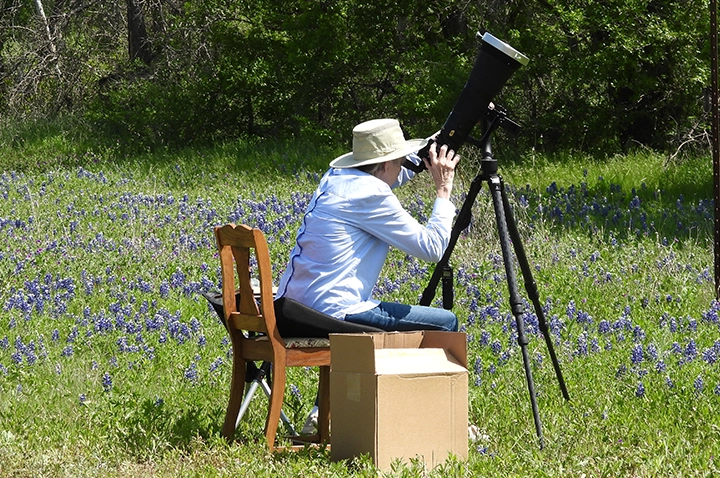
Ginger setting up the camera and checking the settings.
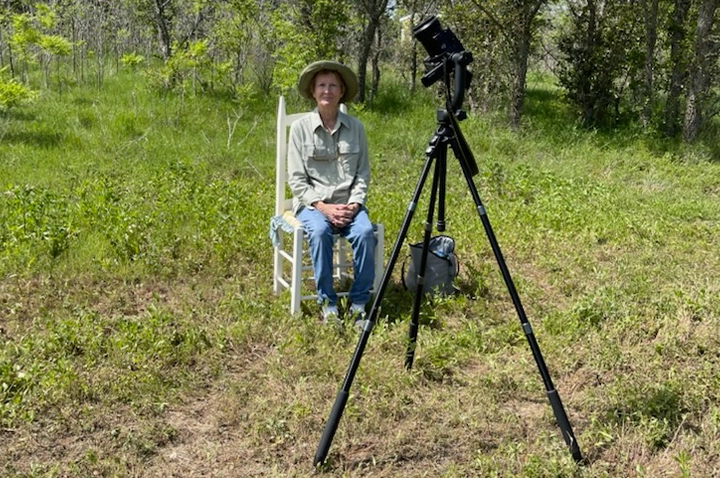
My sister, Shirley, waiting for the eclipse to start.
A couple of hours before first contact, the clouds started to move out of the area and then disappeared into the distance. We had blue skies! The clouds sat ominously, far off on the horizon in the distance, giving us the perfect viewing area to see the eclipse. We waited for the eclipse to start and hoped the clouds would not return.
We counted down the seconds before the partial eclipse phase started and then began capturing photos of the first contact. We took pictures, watched the camera settings, talked about the grandeur of the heavens and what we were witnessing, watched the timer, and waited for totality.
Eight minutes before totality, to ensure there was plenty of time to capture the eclipse with the correct settings and the camera in focus, I changed the camera settings to the predetermined "totality settings" (ISO 400, f/8, 1/60 sec, bracketed to 2 steps overexposed and two steps underexposed). Those camera settings were selected to avoid overexposing the inner portion of the corona. I also refocused the camera, just in case the focus ring on the lens had been bumped when I removed the thumb screws that held the filter to the end of the lens. With the filter left dangling on the end of the lens, the only thing left to do when the big moment arrived was to remove the solar filter and start taking photos.
Finally, it began to get dark, the temperature dropped, and the wind picked up. Then, there was a bright flash of light (Diamond Ring). For just a second, I thought my camera broke because everything in the viewfinder went black. My brother-in-law, Dan, saved the day when he yelled, "Take your filters off!" Totality had arrived!
With the solar filter removed, I started pressing the intervalometer shutter button and quickly checked the camera to make sure the images were in focus. Then, I looked away from the camera to observe the surrounding sky, the dark landscape, and the eclipse, trying to take everything in visually. It was darker and cooler than I expected, and Venus and another star glowed against the dark sky. The eclipse was more beautiful than words can describe.
The best advice I received before the eclipse was 'don't spend all of your time looking at the eclipse through the lens of a camera,' and that proved to be true. The eclipse was astonishing! For the duration of totality, while I observed the eclipse through my eyes and not through the camera lens, my finger stayed on the shutter button to record photos, and I occasionally glanced down at the camera to recenter the sun in the viewfinder. All too soon, there was another bright flash of the Diamond Ring on the back end of the eclipse, and totality was over. Darkness started to disappear, the temperature returned to normal, and the last phases of the partial eclipse resumed.
In the distance, a few small wispy clouds started to drift in a few minutes before the eclipse was over. During the last few minutes of the eclipse, pockets of clouds would cover the area around the eclipse and then move away to expose blue sky. It was like the clouds were telling us to hurry and take the last few shots of the partial eclipse before it was over. Within minutes of the last contact, a bank of clouds returned and covered the sky.
The eclipse was the most beautiful astronomical event I have ever witnessed, and the 2 minutes and 35 seconds of totality seemed like seconds. We still talk about the miracle of the total cloud cover disappearing before the eclipse started and returning minutes after the last contact. We were prepared for Plan B, but we were so grateful that we were allowed to use Plan A. The Earth, Sun, and Moon put on a spectacular, spiritual show on Monday, April 8, 2024.
Click each image below to see a larger image.
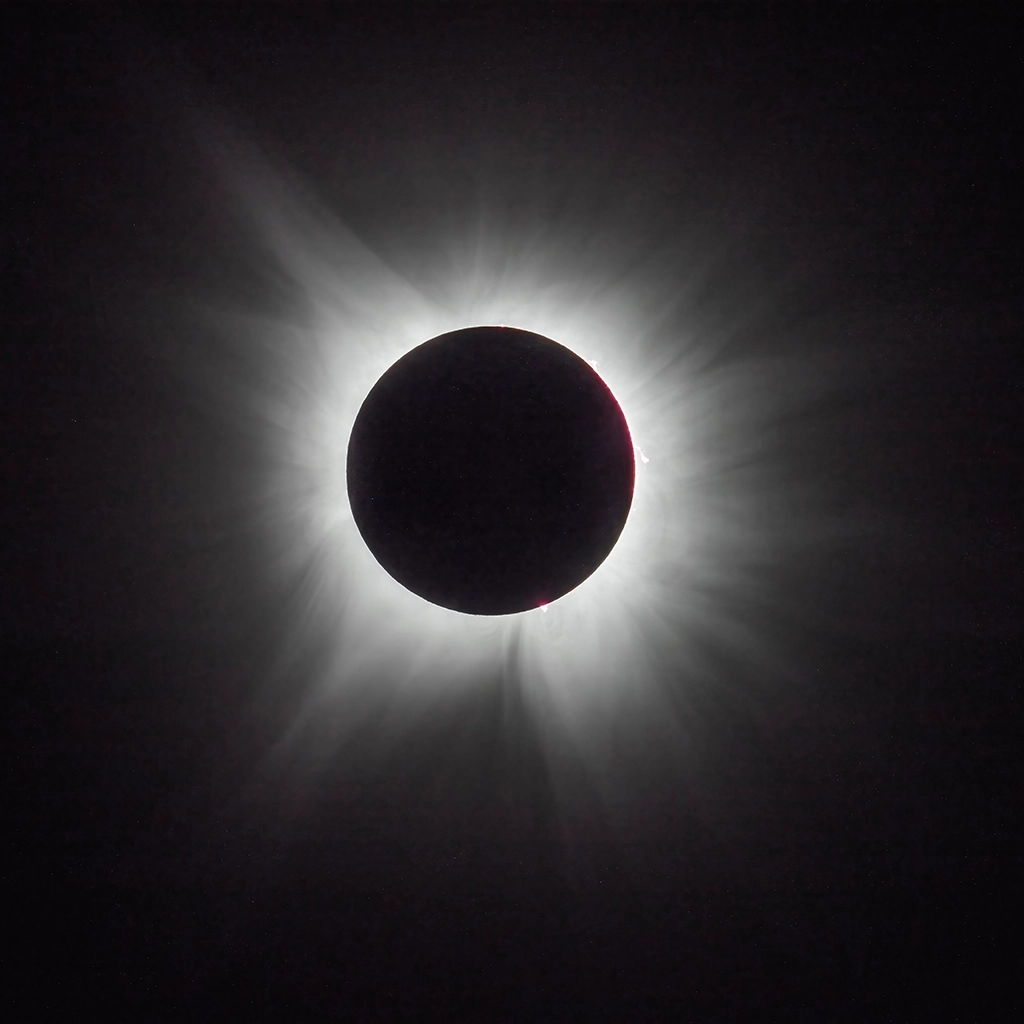
Solar Eclipse © Ginger Wentrcek
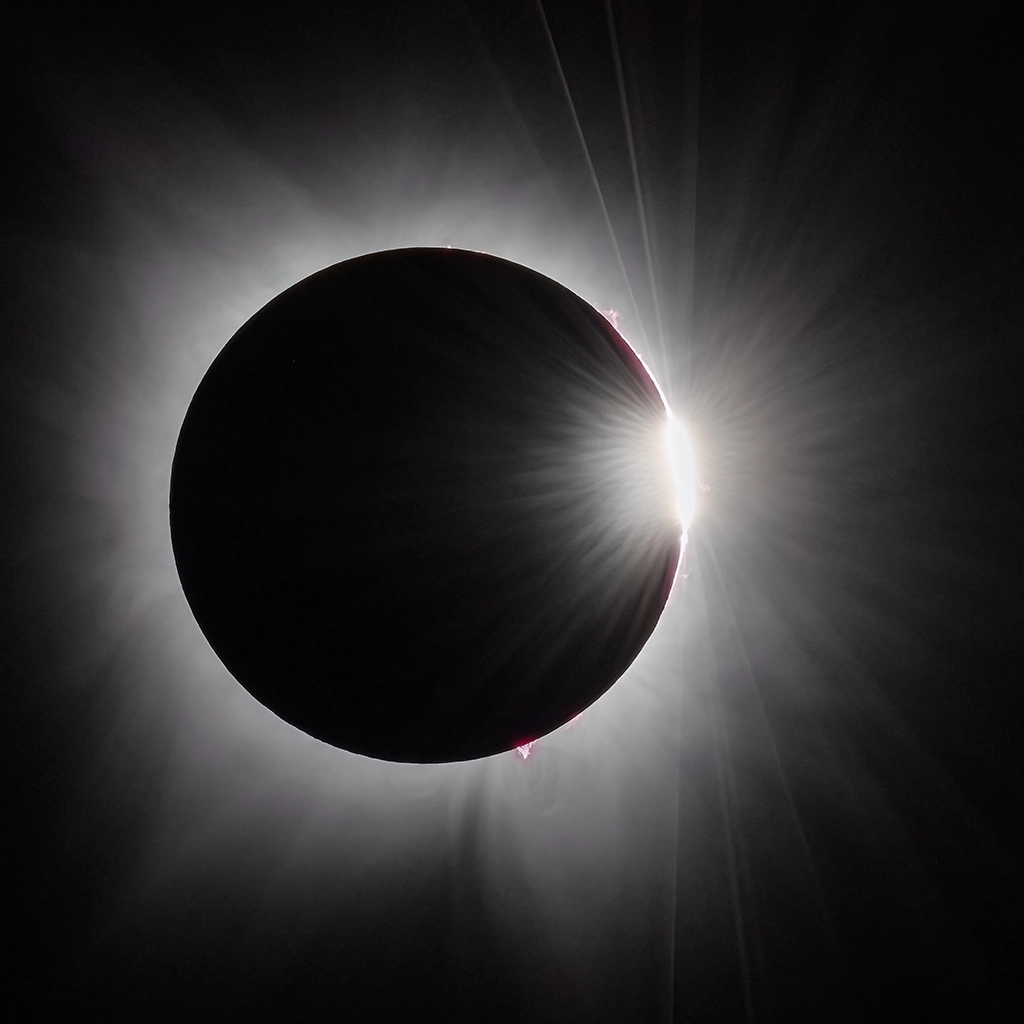
Diamond Ring Phase © Ginger Wentrcek
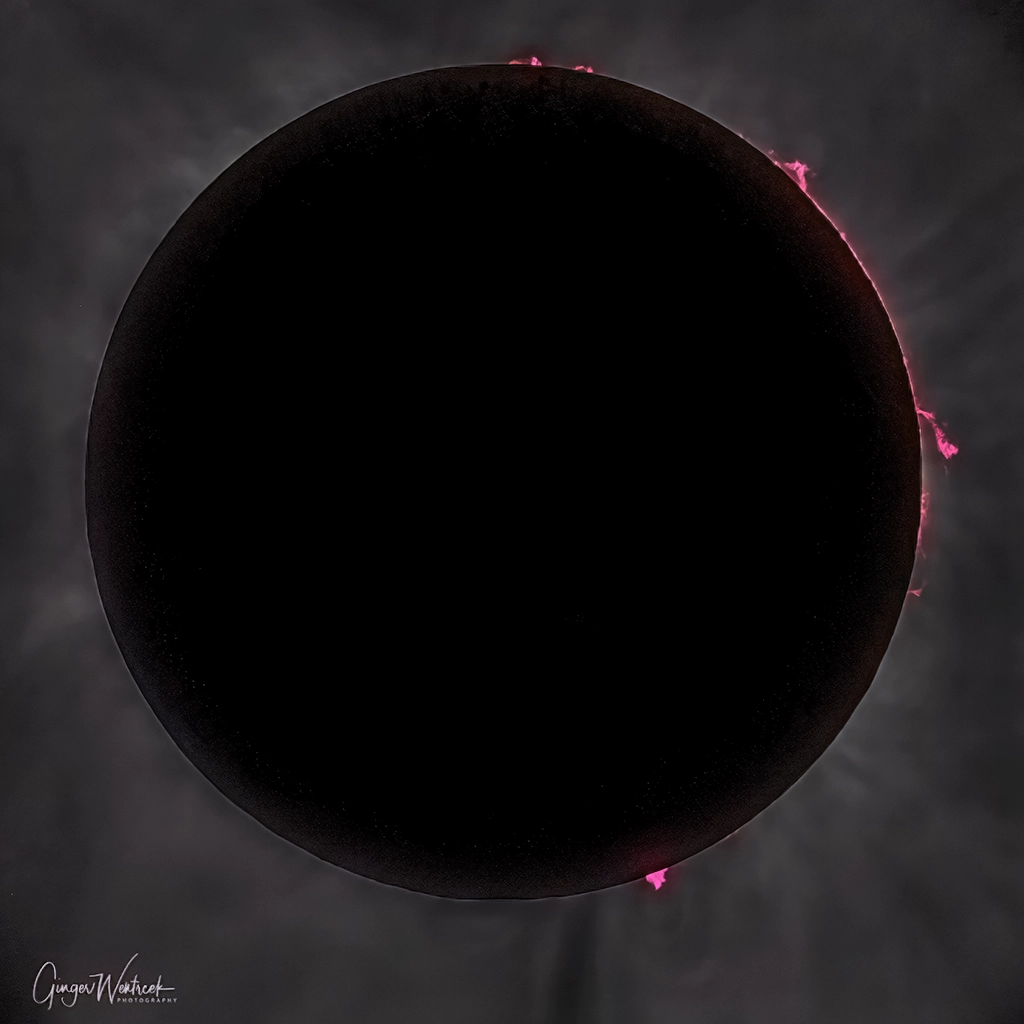
Prominences - Coronal Loops - Chromosphere
© Ginger Wentrcek
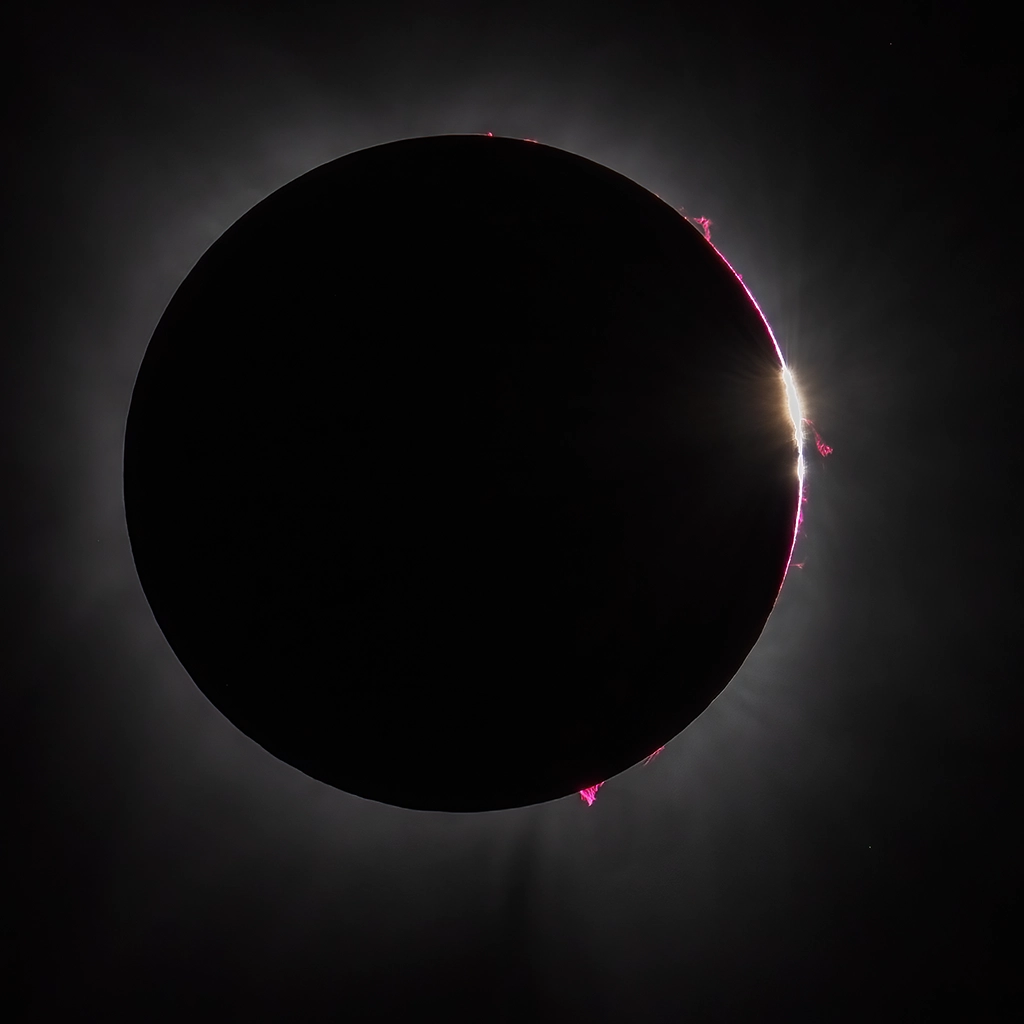
Diamond Ring - Bailey's Beads - Chromosphere -Prominences
© Ginger Wentrcek
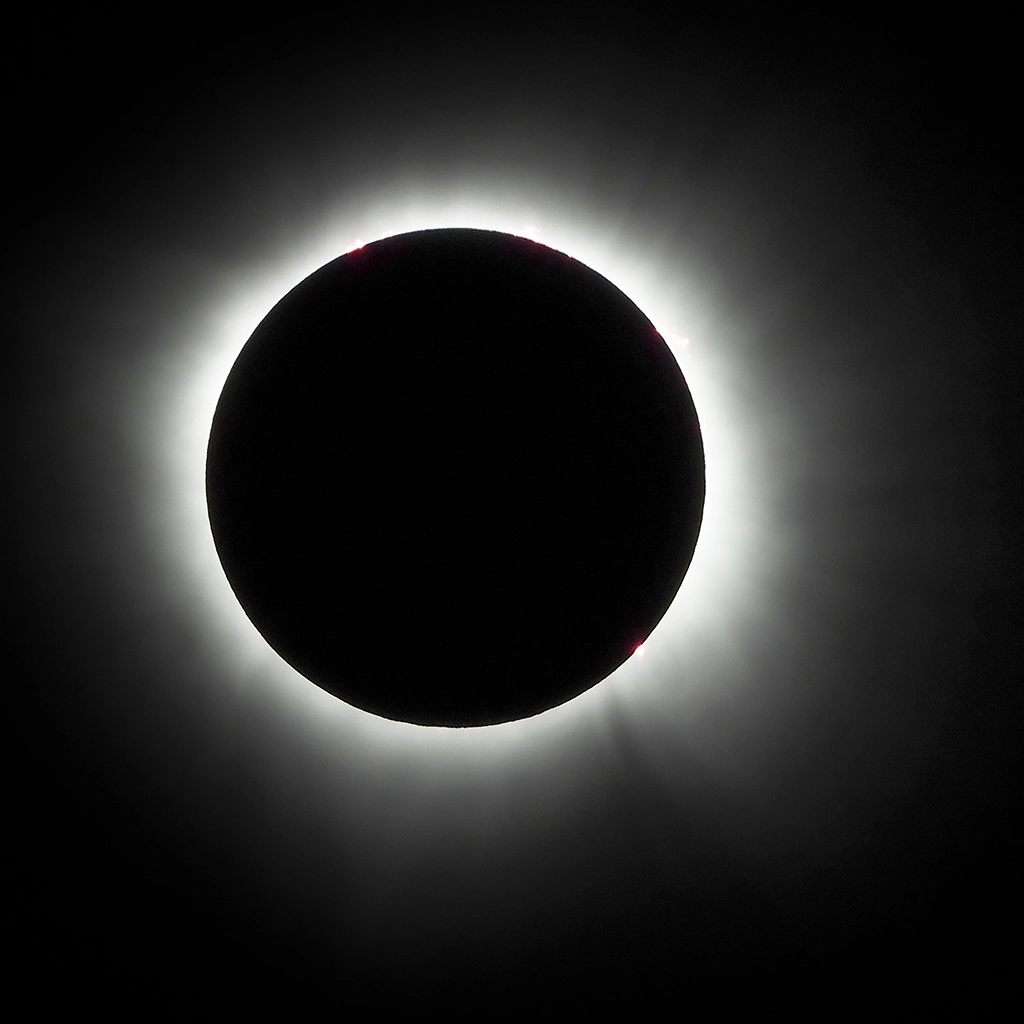
Solar Eclipse with Prominences © Shirley Wilkerson
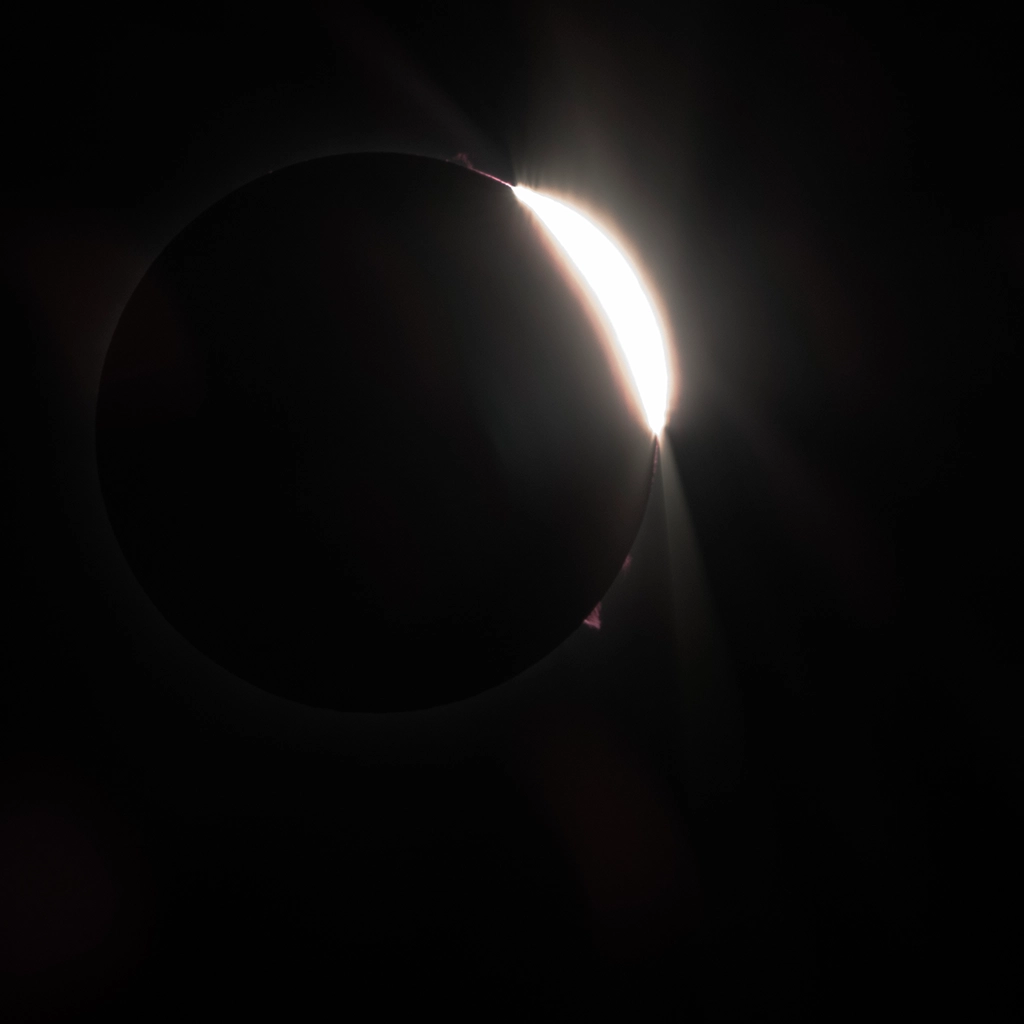
Diamond Ring Phase with Prominences © Shirley Wilkerson
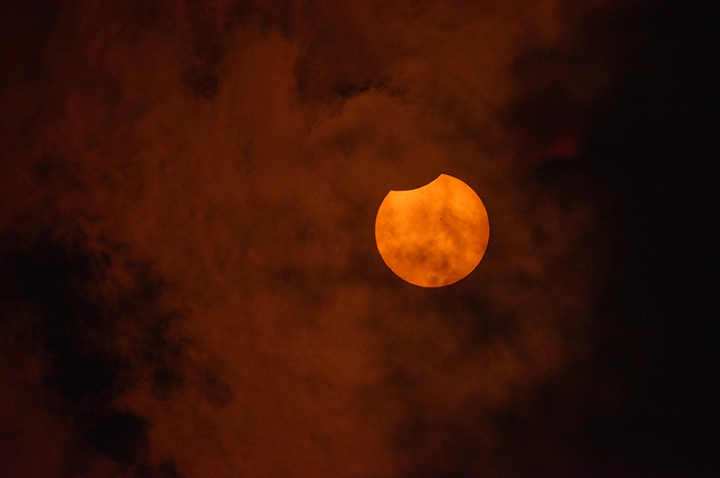
Patches of clouds started to return a few minutes before the end of the eclipse.
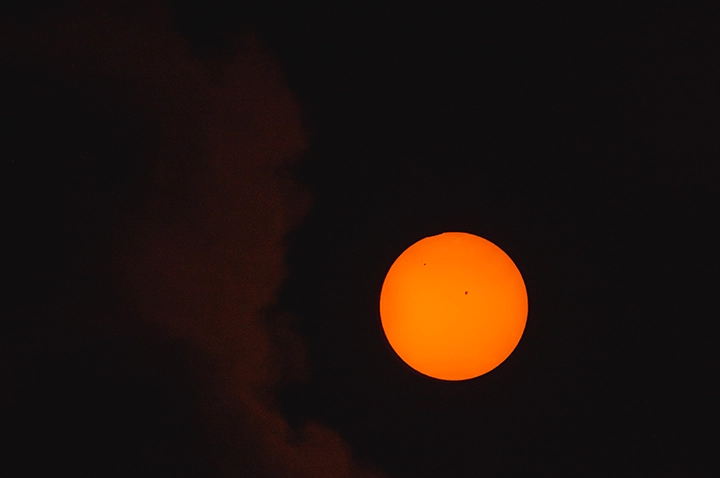
Clouds cleared from around the sun at intervals and we were able to take images of the last stages of the eclipse in patches of blue sky.
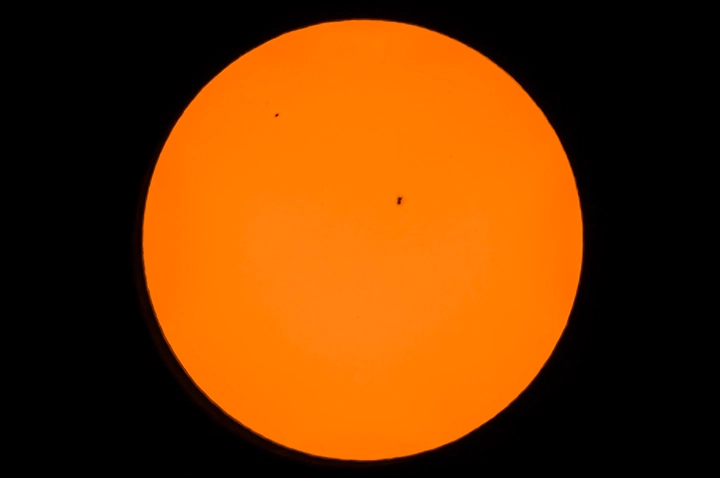
The eclipse is over and the full sun is captured in a patch of blue sky. Seconds later, the sun disappeared under a bank of thick clouds.

About the Author: Ginger Wentrcek
Ginger is a member of the Brazos Valley Astronomy Club and is the current webmaster, newsletter editor, and secretary.

FIND US ON THE WEB:
www.brazosvalleyastronomyclub.org
© Brazos Valley Astronomy Club
Newsletter Editor: Ginger Wentrcek
MEMBERSHIP QUESTIONS:
brazosvalleyac@gmail.com
Treasurer - Lee Smith