
Spring 2024
Spring 2024
By Tom Campbell
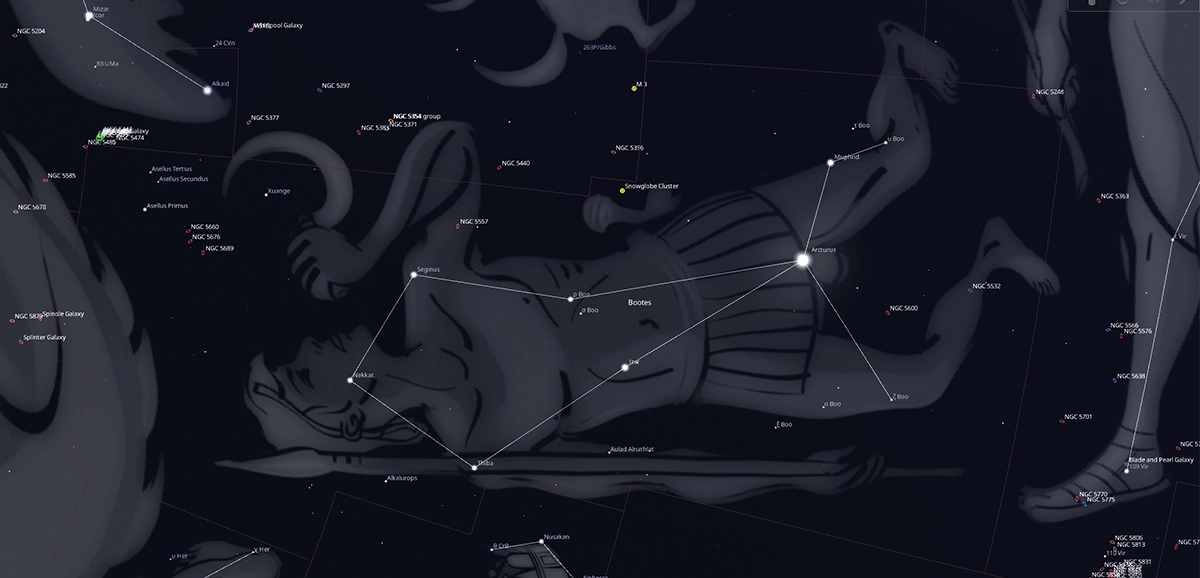
The ancient Greeks gave the constellation the name Boötes, which means Ox Driver, or Herdsman. The oxen are the handle stars of the Big Dipper asterism, as they drag a Dipper Bowl-shaped plough across the sky. Other stories call him a Bear Driver, guiding Ursa Major and Ursa Minor around the heavens.
In Brazil, the Kobeua Indians saw a great Piranha. In modern times, the constellation of Boötes reminds many people of a slightly-mangled kite with two short tails, flying high in the windy spring evenings.
The modern constellation boundaries are home to a large variety of double or multiple stars, as well as a smattering of galaxies and even a globular cluster.
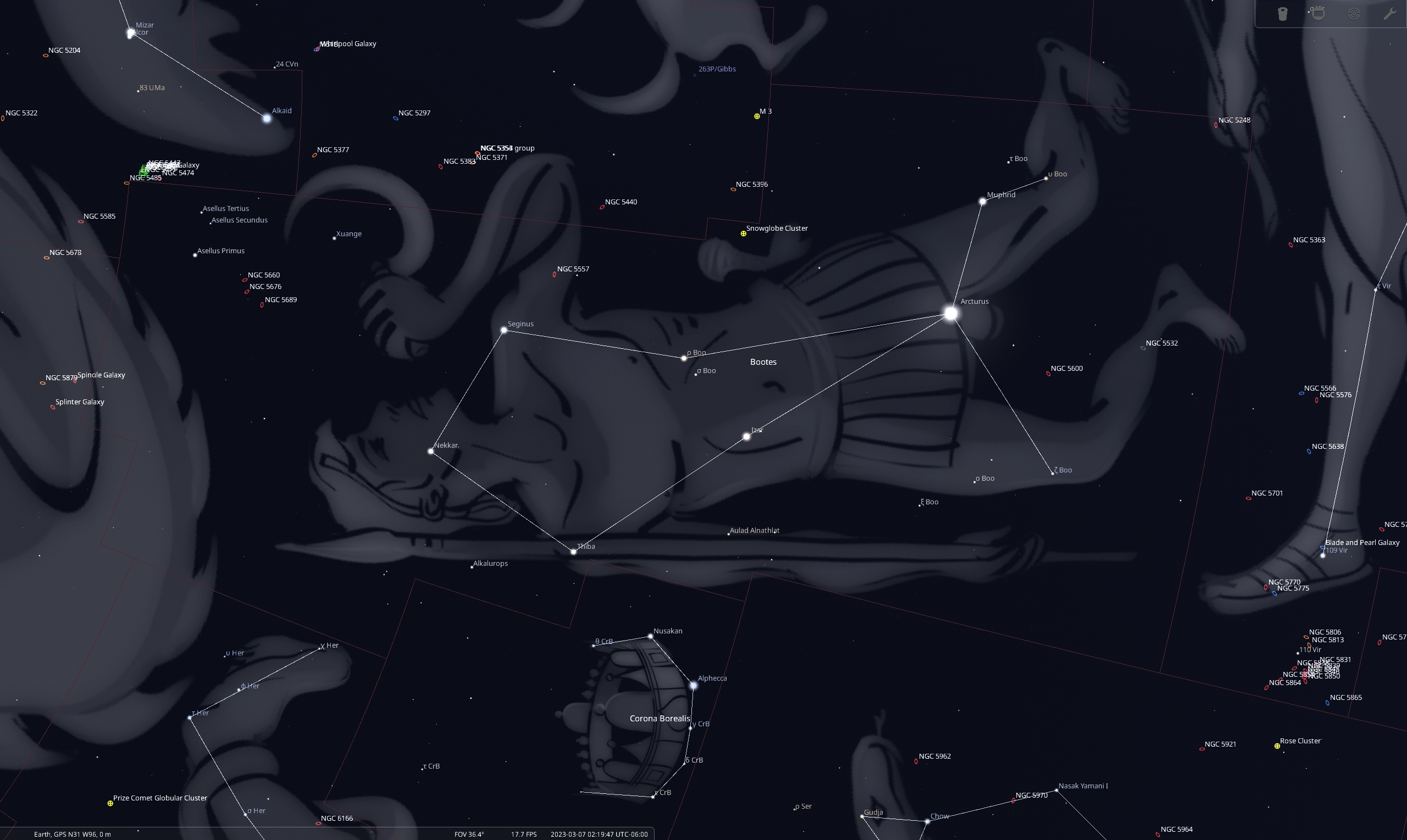
Click image to see full size constellation map.
Image generated by Stellarium v24.1
The modern constellation boundaries are home to a large variety of double or multiple stars, as well as a smattering of galaxies and even a globular cluster.
Arcturus (Alpha [α] Boötis) is easily the brightest member of the constellation and provides a good marker to find the group of stars. If you know how to find the Big Dipper, follow the curved handle of the Dipper and "arc to Arcturus." Arcturus will be the first similarly bright star you see.
The star itself is giant orange star with a spectral classification of K3. It has a similar mass to our own Sun, but is 25 times larger and 170 times as luminous. Arcturus is one of a handful of stars in our night sky that appear non-white to even an untrained naked eye.
Alkalurops (Mu [μ] Boötis) is a quadruple star arranged in two orbiting sets of binary stars; however, only one of the pairs can actually be split visually. All three visual stars are white or pale yellow.
At low magnifications, you'll observe a wide double, with one star appearing a few magnitudes brighter than the other. Raising the magnification, you'll be able to split the fainter star into two nearly equally bright stars.
Pi [π] Boötis is a binary system consisting of a pair of blue-white stars orbiting each other at about 538 AUs apart. For comparison, Neptune orbits the Sun at a distance of 30 AUs. The brighter star, π1, is a class B9 star about 3 times more massive and 214 times more luminous than our Sun.
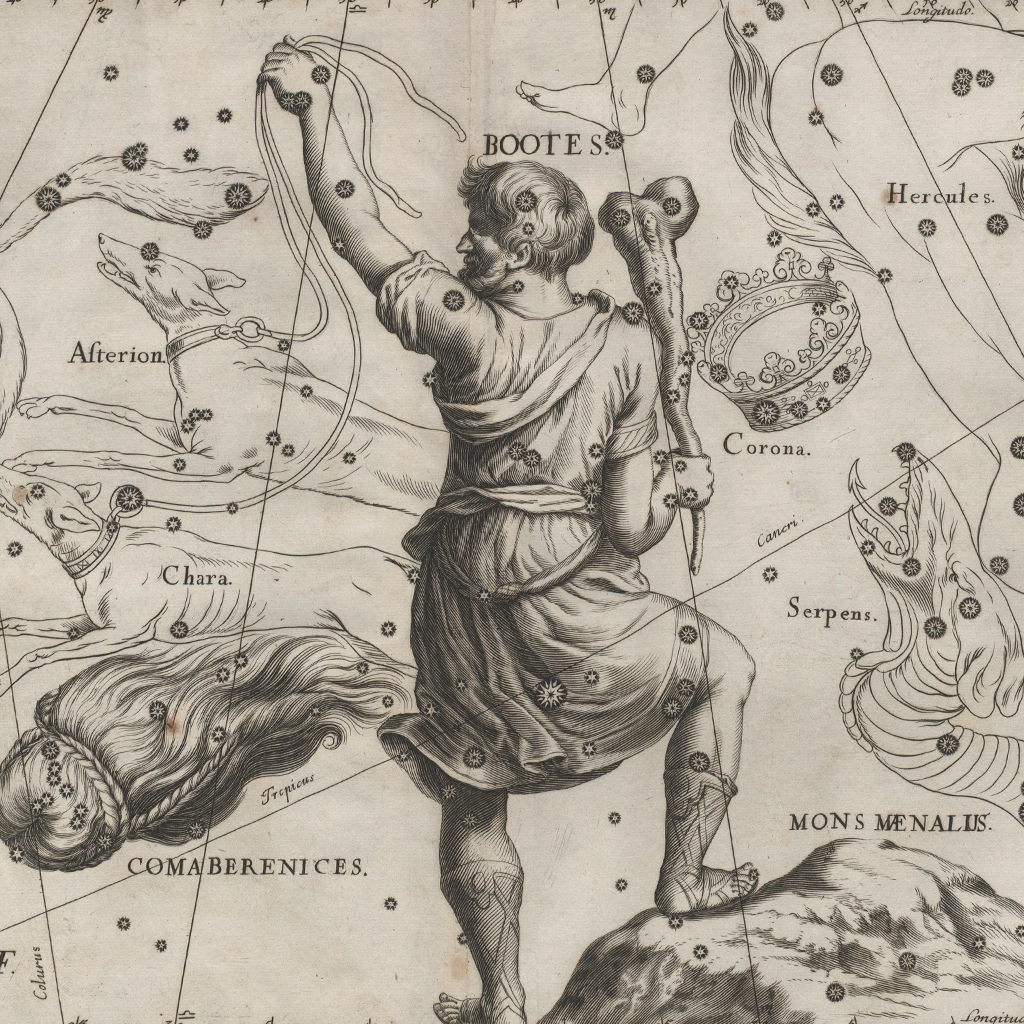 National Library of Poland, Public domain, via Wikimedia
Click to enlarge.
My 8-inch Dob reveals: "This is a fairly tight double. At 49X, I could tell that the star was slightly elongated. 81X gave a strong suspicion of the companion, but it really wasn't cleanly split until I increased the magnification to 122X. Both stars are bright white, with the secondary being about a magnitude dimmer (5.8) than the primary (4.9).
My best view of this double was at 188X. Both stars were obviously split, and yet the magnification was small enough that it still took a while for them to start drifting out of view. A third, fainter star is in the same field, and makes a long, thin triangle with the actual binary. This third star is somewhat bluish in color, and helps to enhance the viewing of this double."
At a distance of only 22 light-years, Xi [ξ] Boötis has the distinction of being the nearest Boötes star system to Earth. It is actually a binary star, with the brighter component being a yellow-white star similar to our own Sun, and its companion being a smaller, orange star.
In an 8" reflector, I observed: "This is a pretty little double. The bright primary is yellowish-white, and the much fainter companion is orange. This makes an interesting color contrast. While the stars are fairly close, they are wide enough that even at 81X, they can easily be separated, and at 49X, the companion is suspected."
Caldwell 45 (NGC 5248) is a compact spiral galaxy located about 59 million light years away. It is a member of the one of the Virgo III Groups of galaxies, and was first observed by William Herschel in 1784. Probably its most interesting feature is a double ring around its nucleus where new stars are being formed at a high rate.
My observing notes from a Bortle 5 sky with an 8-inch telescope show that this one can be challenging. "Finding this galaxy was a star hopping adventure. At this time, Boötes was nearly over the county hospital, and the limiting magnitude was about 4.7. I had to use a low-power eyepiece to find it. I started at Eta (η), which was just visible through my Telrad. From there, I jumped to 70 Vir, and then 71 Vir. From there, I hopped sideways to the double star Burnham 612, and then finally over to my target.
This galaxy was just barely detectable from my backyard. In fact, I missed seeing it the first time I tried to locate it. The spiral galaxy was fairly large and elongated. With direct vision, it almost disappeared completely. Using averted vision, a nearly stellar core was visible. The best view was at 88x, but no spiral structure was visible.
The Snowglobe Cluster (NGC 5466) was also discovered by William Herschel in 1784. It is thought to be the source of a 1.4° stellar stream discovered in 2006 which extends from Boötes to Ursa Major and has been named the 45 Degree Tidal Stream.
In an 8-inch Dobsonian, the cluster was pretty large but extremely faint. It appeared as a hazy patch of light with a bright foreground star nearby. It was round, but the shape was difficult to determine precisely due to the faintness. The best view was at 49x.
Through a 20" Starmaster at 162x, several individual stars were resolved and it took on the definite appearance of a globular cluster.
Another discovery of William Herschel, NGC 5557 is a massive elliptical galaxy. A faint tidal tail has been observed on its eastern side as well as a more complex structure to its west. If both are actually the same structure, it would be one of the largest ever discovered, spanning over 1.1 million light years across. Faint bluish objects on the eastern side are possibly orbiting dwarf galaxies.
Although barely visible in a 6-inch telescope, it will probably require 12-14 inches of aperture to clearly show its bright core and surrounding haze. There is a bright foreground star within the haze, which has been mistakenly reported as a supernova by eager amateur astronomers.
A line of three galaxies are near the top of the constellation, looking as if they're about to be plucked by the left hand of Boötes. The first of these, and the closest, is NGC 5660. It is a face-on spiral galaxy discovered in 1787 by William Herschel, who described it as "pretty bright, large, irregularly round, and with a very gradually brighter middle."
Next in line and in the same field of view is NGC 5676, an asymmetric spiral galaxy with the southern arms extending out twice as far as the northern arms. It is classified as a flocculent (not flatulent!) spiral, meaning that its spiral arms appear patchy rather than continuous.
Using a 16-inch Dobsonian, one observer said: "The galaxy contains a starlike nucleus embedded in a bar-shaped core. The northeast part of the core seems to extend into a short spiral arm. The halo of this galaxy extends more to the southwest. Within the southeast edge of the halo, I could detect a small trace of another spiral arm."
Finally, we come to NGC 5689, a barred spiral galaxy with a couple of prominent dust bands. Through a 10-inch reflector, an observer noted: "At 187x, it's an adorable little guy that looks very much like the archetypical UFO. The core's bulge sticks out more toward the north than the south, and it holds a brighter center."
| Object | Type | Mag(s) | Dist. (ly) | R. A. | Dec. |
|---|---|---|---|---|---|
| α Boö | Orange Giant Star | -0.1 | 37 | 14h 16m | +19° 11' |
| μ Boö | Quadruple Star | 4.3, 7.2, 7.8 | 121 | 15h 24m | +37° 23' |
| π Boö | Double Star | 4.9, 5.8 | 310 | 14h 04m | +16° 25' |
| ξ Boö | Double Star | 4.7, 7.0 | 22 | 14h 51m | +19° 06' |
| NGC 5248 | Spiral Galaxy | 11.0 | 59,000,000 | 13h 38m | +08° 53' |
| NGC 5466 | Globular Cluster | 10.5 | 51,900 | 14h 05m | +28° 32' |
| NGC 5557 | Elliptical Galaxy | 12.2 | 127,000,000 | 14h 18m | +36° 30' |
| NGC 5660 | Spiral Galaxy | 11.9 | 49,600,000 | 14h 30m | +49° 37' |
| NGC 5676 | Spiral Galaxy | 12.3 | 100,000,000 | 14h 33m | +49° 27' |
| NGC 5689 | Barred Spiral Galaxy | 11.9 | 120,000,000 | 14h 35m | +48° 44' |

FIND US ON THE WEB:
www.brazosvalleyastronomyclub.org
© Brazos Valley Astronomy Club
Newsletter Editor: Ginger Wentrcek
MEMBERSHIP QUESTIONS:
brazosvalleyac@gmail.com
Treasurer - Lee Smith