Fall 2025
Fall 2025
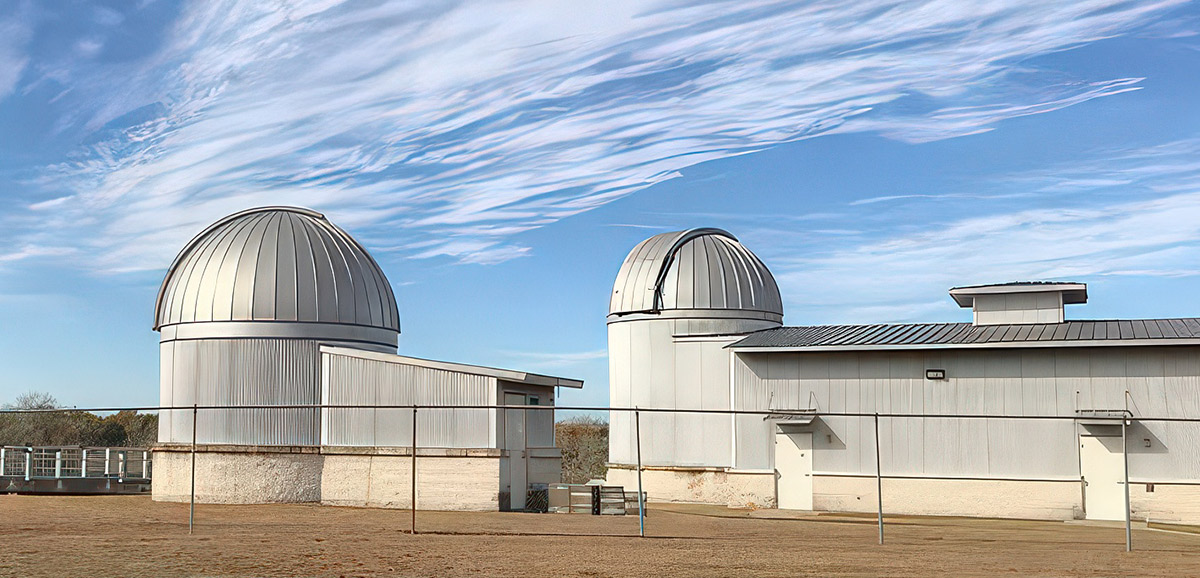
Former members of the Brazos Valley Astronomy Club share stories as they recall meeting and interacting with Don over the years. His dedication to the Brazos Valley Astronomy Club was unwavering, and he inspired many to study the stars and learn about our universe.
Photo at top of page: Don Carona
By Randall Light, MD
Please accept my sincere sympathy and condolences. When I last talked to Don at the July meeting of the Brazos Valley Astronomy Club, he was in good spirits and optimistic. Previously, he had talked to me extensively and vulnerably about his condition. He always remained positive and hopeful.
At one point the club was given a Celestron C90 small telescope. When I took it to a club meeting, Don was quick to recognize and report that a C90 had been used on the International Space Station. He was able to discuss the strengths and weaknesses of the telescope. He then went to his office and reappeared with the exact part I would need to be able to attach an eyepiece to the telescope. He was always eager to help and provide information.
Don provided a real service to the BVAC by being available for the club meeting and welcoming us to the classroom. He was a great source of information on a variety of topics. He is appreciated and will be missed by many. He was a great example of how to face a difficult illness. Please feel free to share these comments with your family and friends. You and your family are in our thoughts and prayers.
Randall Light, MD
President
Brazos Valley Astronomy Club
By Mark Spearman, PhD
I have known Don for almost 20 years. He has been my mentor for astrometry and photometry. I even have a folder on my computer, “Don Carona,” which contains the various applications that he developed and gave to me. He could have commercialized these but they all state that “This application is FREEWARE.” and cannot be sold. He posted many of these applications on the Teaching Observatory website making them available to anyone who wanted them. I use his FitsEdit.jar to organize my files every time I make an observation. Any time I had a problem, Don was always available with good advice and encouragement. I will miss having his support.
But Don has always been generous with his time. He has hosted the Brazos Valley Astronomy Club every month for more than 10 years. He introduced us to some of the top astronomers in the U.S. and invited them to speak to our little group. He always made everyone, newcomers, and long-time members, feel welcome. Many times, after the meeting, he would invite those who stayed into the observatory where the 0.5 meter scope was hooked up to a CCD camera. He even let me “drive” a few times but was always there in case I messed up.
Once, when I got to the Observatory, I did not see Don immediately. I called out and heard his answer from up the stairs. I went up and found him working in what looked like a closet. Later, I realized that was his office because there was no other. As usual, when he helped design the facility, he had put the students first and himself last. He will be missed.
Thank you, Laurie, for sharing him with us. May God bless you and the children.
Mark L. Spearman, PhD
Outreach Coordinator
Former President
Brazos Valley Astronomy Club
By Tom Campbell
I was so sorry to hear about Don. While he may not be able to read this, I wanted to share a few of my favorite memories with him and his family. He's had a profound impact on me, and I'll always be grateful for his guidance and friendship. I hope to read everyone else's memories of Don as well. Maybe we could even compile them for a special commemorative issue of our newsletter?
I still remember the first time I got to know Don beyond small talk at our club meetings. I had mentioned that I wanted to learn more about the observatory telescopes, and instead of brushing it off, he invited me to come up one evening for a private tour. That night, he walked me through every step of how he prepared the telescope for imaging. He didn’t just show me the equipment—he showed me the why behind every action.
After showing me the ins and outs—how to wake up the telescope, rotate the dome, and sync the software—he handed the controls over to me. He told me to pick a target or two, anything I wanted, and try an image. I don’t remember exactly what objects I chose that night, but I do remember the thrill of clicking on a star in the software, pressing a button, and hearing the motors kick in as the telescope spun toward its new position. Then came my favorite part: grabbing the dome controls and chasing the scope around until the dome slit and the optics lined up perfectly. It felt less like operating a machine and more like learning a well-practiced choreography he knew by heart.
What stood out to me was the respect behind that gesture. He knew I’d spent years at the eyepiece of my own telescopes, and instead of treating me like a student, he treated me like a colleague. That night wasn’t just a lesson in how the observatory worked—it was an invitation to share in the rhythm of something he loved.
Don made me feel welcome in a way I’ll never forget. He told me I could come back to the observatory on any clear evening—just call first to make sure he was there. I took him up on that offer more than once, and when I mentioned I wanted to work on imaging the Messier objects, he didn’t just nod politely. He walked me over to the “half-meter” telescope, showed me how its dome and controls worked, and then let me make it my own. While he was in the big dome tracking asteroids, I was in the smaller one capturing galaxies and clusters, each of us doing our own work under the same sky.
Eventually, he handed me a key and even showed me how the alarm system worked. "Come up anytime," he said, "even if I’m not here." That kind of trust meant a great deal to me. It wasn’t just access to a telescope—it was the gift of belonging, of feeling like I was a part of his team.
One of my favorite projects with him came a few years later, when he pulled me aside before a club meeting with a gleam in his eye. “I’ve got an idea,” he said. “Let’s see if we can detect Pluto’s moon Charon with the 24-inch.” The thought alone floored me. Pluto itself is no more than a faint dot in the sky—Charon seemed almost impossible. Of course, I agreed immediately.
He worked out the best nights to try by checking online tables for when Pluto and Charon would be at their widest separation. Then, in the spirit of Clyde Tombaugh, who discovered Pluto back in 1930, we lined up the telescope, snapped an image, and came back the next night for another. Side by side, the pictures looked identical—until one somewhat faint "star" shifted slightly. That was Pluto.
From there, we zoomed in until the image was nothing but squares of light. Pixel by pixel, we compared brightness levels, hunting for anything unusual around Pluto’s tiny glow. And there it was: a small bump, just a few shades brighter than the background, sitting exactly where the charts said Charon should be. We had done it.
That night, I saw Pluto for the first time—and, almost unbelievably, one of its moons. But what made it unforgettable wasn’t just the discovery. It was sharing that moment with Don, doing the kind of hands-on, patient detective work he loved. I knew it was a project he could have easily done on his own, but the fact that he invited me to be part of it is something I’ll always treasure. It felt like we’d reached back through history, retracing the steps of Tombaugh himself, and added our own small chapter to the long story of looking deeper into the night.
Tom Campbell
Former Outreach Coordinator
Brazos Valley Astronomy Club
By Dharma Palagugu
I’m so sad to hear about Don. He welcomed me the first time I was there for BVAC meeting, showed the observatory and told to reach out to him anytime I need to use any of the observatory equipment.
While many people are friendly and offer help, Don kept his word. He was quick to respond to my questions about different types of telescopes, mounts and many more. I feel lucky to know Don and deeply thankful for the conversations.
Praying for his family.
Dharma Paladugu
Member
Brazos Valley Astronomy Club
By Ginger Wentrcek
I always enjoyed talking to Don at our astronomy club meetings and getting his opinion about future projects. I read an article about photographing geostationary satellites, and the thought of capturing a line of dots over 22,000 miles above the Earth's surface with nothing more than a camera was intriguing. I did not capture the "line of dots" on my first effort and was very disappointed. Then, Don sent me an article about geostationary satellites he wrote for the astronomy club newsletter, and I talked to him about my project. He took the time to explain the difference between a geostationary orbit and a geosynchronous orbit and told me how to locate my targets. We had a great discussion about what types of satellites orbited above the celestial equator and those with a north-south orbit. On my next try, I located them and was thrilled to see the "line of dots" when I downloaded the images on my computer. But what gave me even more satisfaction was the smile and nod of the head when I showed the images to Don, and he replied, "Yes, you got them." He pointed out the fact that I also captured a very faint orbit of a north-south satellite in one of the images, and there was a faint reflection of the Orion Nebula in the background.
On another occasion, the astronomy club hosted a group of teachers on a Saturday, and members of the club took turns leading a variety of hands-on astronomy lessons that the teachers could use with their students. What struck me was that Don was not just a great teacher, he was a teacher's teacher. His skill working with the group of participants, who had various levels of knowledge about astronomy, was amazing to watch. He visited each group and guided each of them as they worked through the different projects. Many teachers walked away from that Saturday session with a deeper understanding and appreciation of astronomy and how they could transfer that knowledge to their students.
Don was the kind of person who made friends with everyone, was approachable, and generously shared his time and knowledge to promote the love of astronomy. His willingness to lend a helping hand and share experiences made a lasting impact on the lives of everyone he met.
It was an honor to know Don. God bless you and your family.
Ginger Wentrcek
Secretary, Webmaster, Newsletter Editor
Brazos Valley Astronomy Club
By David Barry
Don is a truly inspiring person. He has made an incredible impression in my life. My heart is heavy and I will pray for him and his family.
David Barry
Former Secretary
Brazos Valley Astronomy Club.
FIND US ON THE WEB:
www.brazosvalleyastronomyclub.org
© Brazos Valley Astronomy Club
Newsletter Editor: Ginger Wentrcek
MEMBERSHIP QUESTIONS:
brazosvalleyac@gmail.com
Treasurer - Lee Smith